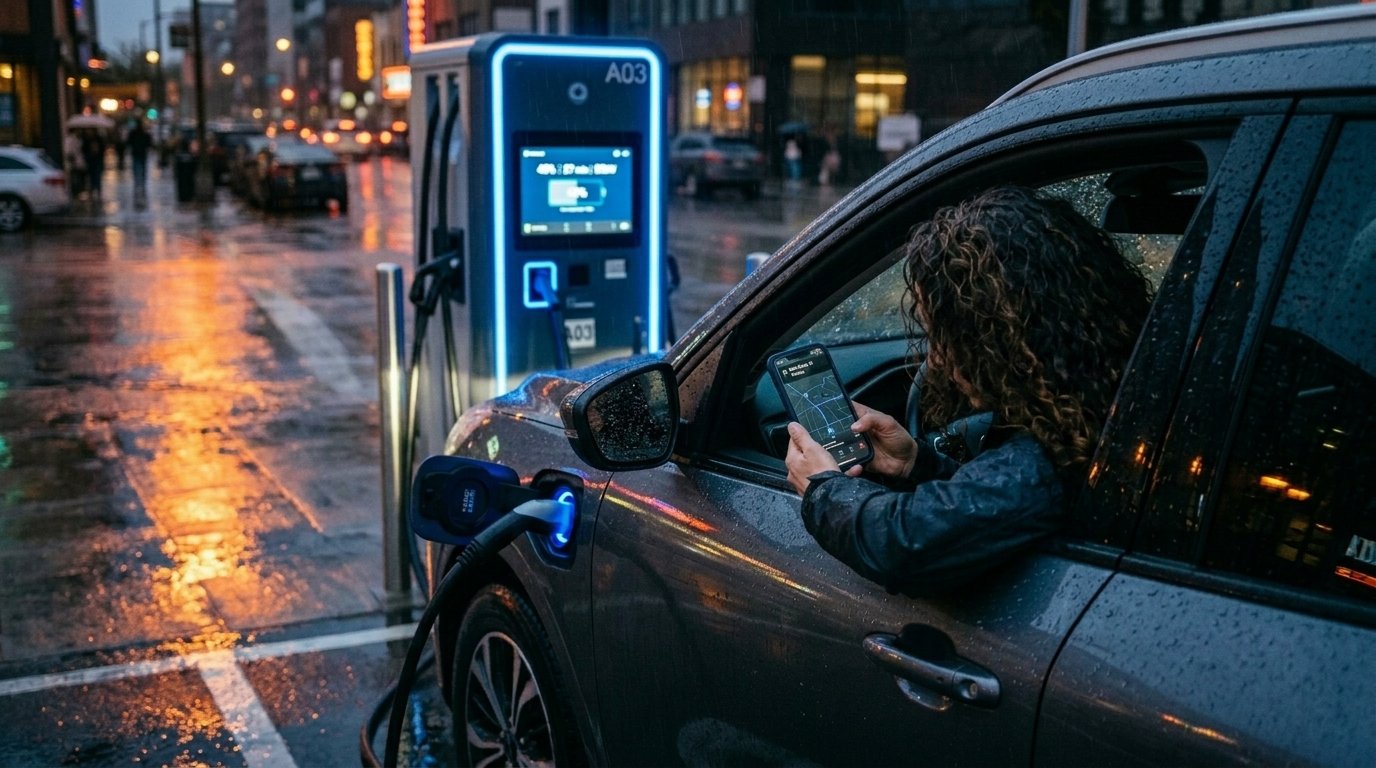
Let me tell you about Tuesday. 11 PM. I drove to a friend’s place and didn’t think about range — because I never think about range until it’s too late. My 2019 Chevy Bolt showed 32 miles left. I was 18 miles from home. Fine, right? Plenty. I’ve been hunting EV charging stations near me long enough to know that “plenty” means nothing until you’re actually plugged in.
Except the fast charger I always use? Blocked. By a pickup truck. Not charging. Just parked there. Like a message.
My phone was at 12%. The car was yelling at me. And for a minute, I actually felt that panic again. The one I thought I’d gotten over two years ago.
Then I laughed. Because this is just how it goes. Finding a charger isn’t the hard part anymore. Finding one that works — that you can actually use without downloading three apps and sacrificing a goat? That’s the trick.
Let me walk you through what I’ve learned. The real stuff. Not the marketing.
First, Stop Using Google Maps for EV Charging Stations Near Me
Seriously. Just stop.
Google Maps will show you a beautiful little forest of green pins. “EV charging stations near me!” Lovely. Except half of those pins belong to a dealership that locks its gates at 6 PM. Or they’re Tesla Superchargers that won’t talk to your car. Or — and this one hurts — they show as “available” but are actually occupied by a Nissan Leaf that’s been sitting at 98% for two hours because the owner went shopping.
You need different tools.
The Three Apps That Actually Work
Plug Share — Think Yelp for EV chargers. Real people post real photos. They leave comments like “Stall #2 is slow” or “Broken, don’t bother.” This app has saved me more times than I can count. It’s free. Get it.
A Better Routeplanner (ABRP) — The ugliest app on my phone. Looks like it was designed in 2010. But it factors in elevation, wind, temperature, and your specific car’s battery degradation. For road trips? Unbeatable.
The network’s own app — Electrify America, EVgo, ChargePoint, Tesla. Download them now. Don’t wait until you’re standing in the rain with 5% battery and a spinning loading wheel.
The Actual Workflow When You Find EV Charging Stations Near Me
Okay, you found a pin. You drove there. Now the fun begins.
Step 1: Check the Plug
This sounds dumb. But I’ve watched a grown man spend five minutes trying to force a CCS plug into a J1772 hole. They look kind of similar if you squint. They’re not. Don’t be that guy.
Here’s your quick cheat sheet:
J1772 — Round plug. Slow charging (Level 2). Think movie theaters, hotels, office parking lots.
CCS — Big and chunky. Fast charging. Your road trip savior.
NACS — Tesla’s plug. More cars are getting adapters for these now.
Step 2: The Payment Dance
Every network has its own ritual. And none of them make sense.
Electrify America wants you to tap your phone — unless the reader is broken, then you use the app, but sometimes the app won’t connect, so you swipe a credit card, except the card reader only works half the time.
ChargePoint makes you tap your phone and confirm in the app simultaneously. Two-factor authentication for electricity. I’m not joking.
The pro move: Set up “Plug & Charge” if your car supports it (Tesla, Ford, GM). You plug in. It just works. Like magic, but real.
Step 3: Speed Check — Not All Fast Chargers Are Fast
Level 2 — 20–30 miles of range per hour. Good for sleeping or a long movie. Useless if you’re in a hurry.
DC Fast Charger — 100–200 miles in 20–30 minutes. But check the kW number. A 50kW charger is slow-fast. A 350kW charger is actually fast.
Here’s the kicker: your car has a maximum charging speed. My Bolt tops out at 55kW. Plugging into a 350kW charger is like putting race fuel in a lawnmower. It won’t hurt anything, but it won’t charge faster either.
Unwritten Rules for Using EV Charging Stations Near Me
Don’t Be the Leaf Owner
I love Nissan Leafs. Nice cars. But they use Chademo — an old Japanese plug standard — and they charge slowly. If there’s a line and a Leaf is at the only fast charger? Just leave. It’s not their fault. But physics is physics.
Unplug at 80% in Public
When your car hits 80%, charging speed drops like a rock. That last 20% can take as long as the first 80%. If people are waiting and you’re sitting at 89%, congratulations — you’re the villain now. Move your car.
Broken Stall Roulette
Expect one out of four chargers to be broken, offline, or “reduced speed.” That’s just reality right now. Read the PlugShare comments before you get out of the car. They’ll tell you: “Stall 3 error code 42.” Stall 3 is cursed. Use Stall 1.
What Nobody Warned Me About EV Charging Stations Near Me
The cables are heavy. Gym-membership heavy. In winter, they get stiff and angry. I’ve wrestled with CCS cables that felt like frozen anacondas. Your forearm strength will improve.
The noise. When you fast charge, your car’s cooling fans kick in hard. Sounds like a small airplane preparing for takeoff. Passengers will ask, “Is it supposed to do that?” Yes. It’s fine. It’s just sweating.
The charging curve lie. Your car’s window sticker says “200 kW max charging!” Great. But that only happens between 15% and 35% battery, at perfect temperature, with the wind at your back. After 50%, it drops. After 70%, you’re lucky to get 50kW. This isn’t a flaw — it’s battery chemistry. But nobody puts that on the sticker.
The 30-Second Cheat Sheet
If you forget everything else, remember these four things:
Get PlugShare. Use it. Leave a comment when you find a broken charger — help the next person.
Follow the 20–80% rule.We covered this in detail in our electric car battery cost guide. For daily driving, keep your battery between 20% and 80%. Only charge to 100% right before a long road trip.
Always have a backup station. The first one will be broken or full. Plan for two.
Tesla Superchargers work with most new EVs if you buy a $200 adapter. If you’re still deciding which EV to buy, check our best electric cars in 2026 guide first.The cables are short — you’ll have to park sideways, which we all do — but they work every time. When you’re scouting EV charging stations near me on a road trip, Tesla’s network is still the most reliable option in most areas.
A Quick Question for You
I’ve told you my chaos. Now I want to hear yours.
Ever drive 15 minutes to a “fast charger” only to find a slow Level 2 and a four-hour sit? Ever find a perfect station behind a locked gate at 10 PM? Ever wrestle with an app that crashed three times while your battery ticked down to 2%?
Drop your horror story in the comments. I’ll read every one. Misery loves company, and EV charging misery loves cheap coffee and a working stall.
Now go charge something. And seriously — move your car at 80%.