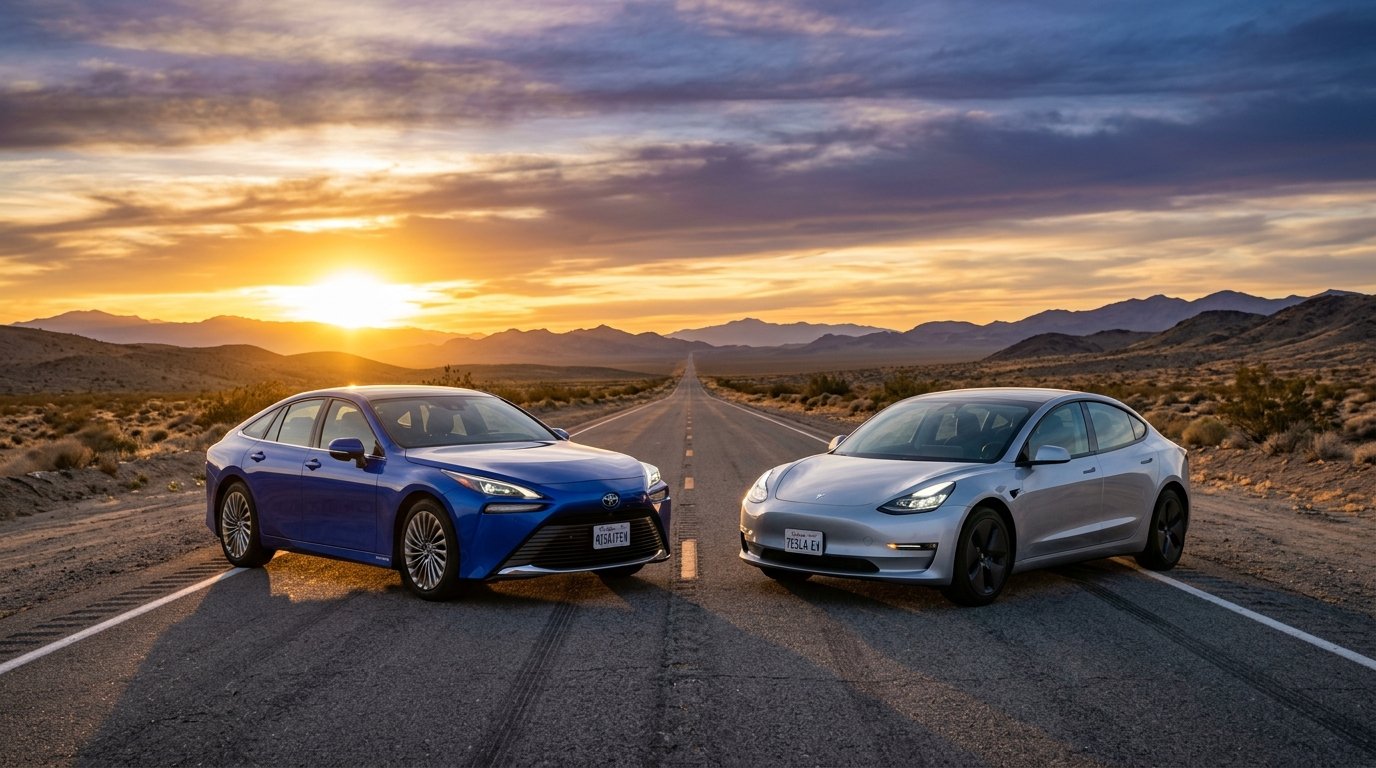
So last spring I was done with my diesel hatchback. Done. The thing had hit 180,000 kilometers and I’d already spent more on repairs in two years than I care to admit out loud. So naturally I did what any slightly-obsessive person does — I fell headfirst into researching every possible alternative.
I’d been looking at EVs for months. Test drove a Model 3, spent an embarrassingly long time sitting in a Hyundai IONIQ 5 at the dealership pretending I was “still deciding.” Even looked at a used Nissan Leaf before a friend talked me out of it. But then at a casual tech meetup — the kind where half the people are just there for the free pizza — a guy I barely knew mentioned he’d been following hydrogen fuel cell vehicles for two years and thought they were quietly becoming something real.
That comment lived in my head for weeks.
I started reading everything I could find. Manufacturer whitepapers, Reddit threads from actual hydrogen car owners in California and Japan, YouTube deep dives from engineers who clearly knew far more about chemistry than I do. And I had real conversations with people who drive Toyota Mirais and Hyundai NEXOs as their everyday cars. Not “I tried it once” people — daily drivers.
What I found was genuinely more complicated than I expected. And if you’re trying to figure out which of these technologies actually makes sense — for your life, or just for the world in general — here’s everything I pieced together.
How These Two Technologies Actually Work
I’ll be upfront — I had a pretty fuzzy idea of how hydrogen cars work when I started, and I think a lot of people do. So let me explain it the way I eventually understood it.
Battery Electric Vehicles (BEVs)
Electric cars — the kind most people picture when they hear “EV” — store electricity in a big battery pack. Think of it like a giant phone battery. You plug it in overnight, it charges up, you drive, you plug it in again. Straightforward enough.
Hydrogen Fuel Cell Vehicles (FCEVs)
Hydrogen cars are also electric, which surprises a lot of people. The difference is they generate their electricity on the go, using a fuel cell. Hydrogen goes in, meets oxygen from the regular air, a chemical reaction happens, electricity comes out — and the only thing the car “emits” is water vapor. Actual water vapor. I watched a video of someone holding a cup under the exhaust pipe to collect it. Weird, but kind of cool.
The hydrogen itself sits in reinforced tanks at extremely high pressure — around 700 bar, which sounds alarming until you learn they drop those tanks off buildings and shoot them with rifles during testing. They’re genuinely built to take abuse. And refueling takes about three to five minutes. Like a regular gas station stop. More on why that matters in a bit.
Both types are clean at the tailpipe — zero CO₂ while you’re driving. The real debate is everything that happens before you get in the car.
Why I Still Ended Up Going Electric — For Now
If someone asked me right now — “I need a car, what do I do?” — I’d still say go electric. Not because hydrogen is bad, but because of where things actually are right now.
The Infrastructure Gap Is Real
The charging setup for EVs has gotten kind of remarkable, at least in bigger cities. I can think of three charging points within walking distance of my apartment. The nearest hydrogen station? About 140 miles away, in a city that got a pilot program a couple of years ago. That’s not just inconvenient. That’s a no-go for regular life.
Home Charging Changes Everything
This one snuck up on me. I spent a week with a friend’s Model Y, and every morning the car was fully charged — because he’d just plugged it in the night before like a phone. No trips to a station, no planning. Just always ready. You can’t do that with hydrogen. There’s no home setup for regular consumers, and there probably won’t be for a very long time.
The Cost Math Doesn’t Favor Hydrogen Yet
EVs have come down a lot in price. Used ones are a real option now. Hydrogen cars, even with government incentives, are still pricier — and the fuel itself isn’t cheap unless you’re near subsidized infrastructure. Apps like PlugShare and ABRP (A Better Route Planner) have also made the EV ownership experience genuinely manageable. Not seamless, but workable. The whole ecosystem around EVs has quietly matured.
Where Hydrogen Actually Has a Strong Argument
Here’s where I think a lot of mainstream coverage gets lazy — they declare EVs the winner and move on. But that misses something important.
Refueling Speed for Heavy Transport
A long-haul truck cannot sit at a charger for 45 minutes every few hundred miles. The economics don’t work. The logistics don’t work. Drivers aren’t paid to wait. Hydrogen gets you refueled in the time it takes to drink a bad cup of truck-stop coffee. Toyota, Hyundai, and Daimler aren’t spending billions on hydrogen freight trucks as a PR move — they’re doing it because the numbers actually make sense for that use case.
Cold Weather Is a Legitimate Problem for Batteries
Battery range drops in cold temperatures — sometimes by 25 to 40 percent. I had a friend in northern Sweden who kept an EV for about a year and a half before giving up on it during winter. Hydrogen fuel cells handle cold much better. If you live somewhere that gets genuinely brutal winters, that’s not a small consideration.
The Weight and Range Compounding Problem
This one doesn’t get talked about enough. Adding range to a battery EV means adding more battery weight, which means the car needs more energy to move, which means you need even more battery… it spirals. Hydrogen doesn’t have that problem in the same way, which is why aviation and shipping industries are taking it seriously for heavy, long-distance applications.
The Efficiency Argument — Let’s Be Honest About This
There’s one number that changed how I think about this whole debate, and I want to be straight with you about it.
When electricity travels from the power grid into a battery and then to the wheels, the process is roughly 70–80% efficient. Pretty good.
The hydrogen pathway is different. You generate electricity → use it to split water into hydrogen → compress and transport it → run it through a fuel cell → then power the motor. Each step loses energy. By the end, you’re looking at around 25–35% efficiency from original energy source to wheels. Significantly worse.
So Does That Mean Hydrogen Loses?
Not entirely. Here’s the part people skip over.
Hydrogen can be shipped in tankers to places where you can’t easily run power lines. It can store surplus energy when solar and wind produce more than the grid needs, then release it later. That has real value — for the grid, for remote regions, for industrial use. It’s not just about powering cars. Sometimes the “less efficient” technology solves a problem the efficient one can’t.
Mistakes I Made When I Started Researching This
For a while I was pretty dismissive of hydrogen — too expensive, infrastructure nowhere near ready, efficiency numbers too bad. I was confusing “not ready right now” with “will never be ready,” which is a mistake I’ve made before with new tech and I should’ve known better.
I also got weirdly tribal about it. Spent time in forums where people were intense about defending one side or the other, and I started absorbing that energy. It wasn’t useful. Different technology for different problems is just how things work — it’s not a religion.
The other thing I underestimated was how fast green hydrogen is moving. Right now, most hydrogen is “grey” — made from natural gas, which isn’t really clean. But green hydrogen, made by splitting water with renewable electricity, is getting cheaper. There are real projects in Australia, Chile, and Norway building actual large-scale infrastructure. It’s not fully here yet, but it’s not theoretical anymore either.
Hydrogen vs Electric Cars: Where Each One Actually Makes Sense
Rather than picking a winner, here’s what the honest breakdown looks like right now.
Electric cars make the most sense if you live in a city or suburb, have access to home or workplace charging, do most of your driving within a few hundred kilometers, and want a lower overall cost of ownership today.
Hydrogen cars make more sense if you drive long distances regularly, need fast refueling and live near hydrogen infrastructure, operate heavy commercial vehicles, or live in an area with extreme cold weather and unreliable electricity.
The technology that “wins” for you depends entirely on which of those situations you’re in.
So Which One Is the Future?
Honestly? I think asking “which one wins” is kind of the wrong question.
For everyday people, in cities, in most countries — electric cars have a commanding lead right now. The infrastructure is there, the costs are workable, home charging is genuinely life-changing in small ways, and the technology keeps improving. If you’re buying a car this year, that’s probably your answer.
But for long-haul freight, aviation, shipping, heavy industry, and remote regions — hydrogen has a real future. Not a maybe-someday future. A companies-are-spending-billions-on-it future.
I ended up leasing an EV. Made the most sense for my life, my city, my daily needs. But I follow hydrogen news more closely than I expected to. Because the story feels unfinished in an interesting way — and that’s not a bad thing.
The most honest thing I can say is this: the future of clean transport probably doesn’t have one winner. It looks more like a mix — the same way we have different planes for different routes, different fuels for different machines. And once I stopped waiting for a single answer, the whole thing got a lot more interesting to follow.
Have you driven a hydrogen or electric car? Or tried one and gone back to gas? I’d genuinely love to hear how it went — the real experiences are always more useful than the spec sheets.