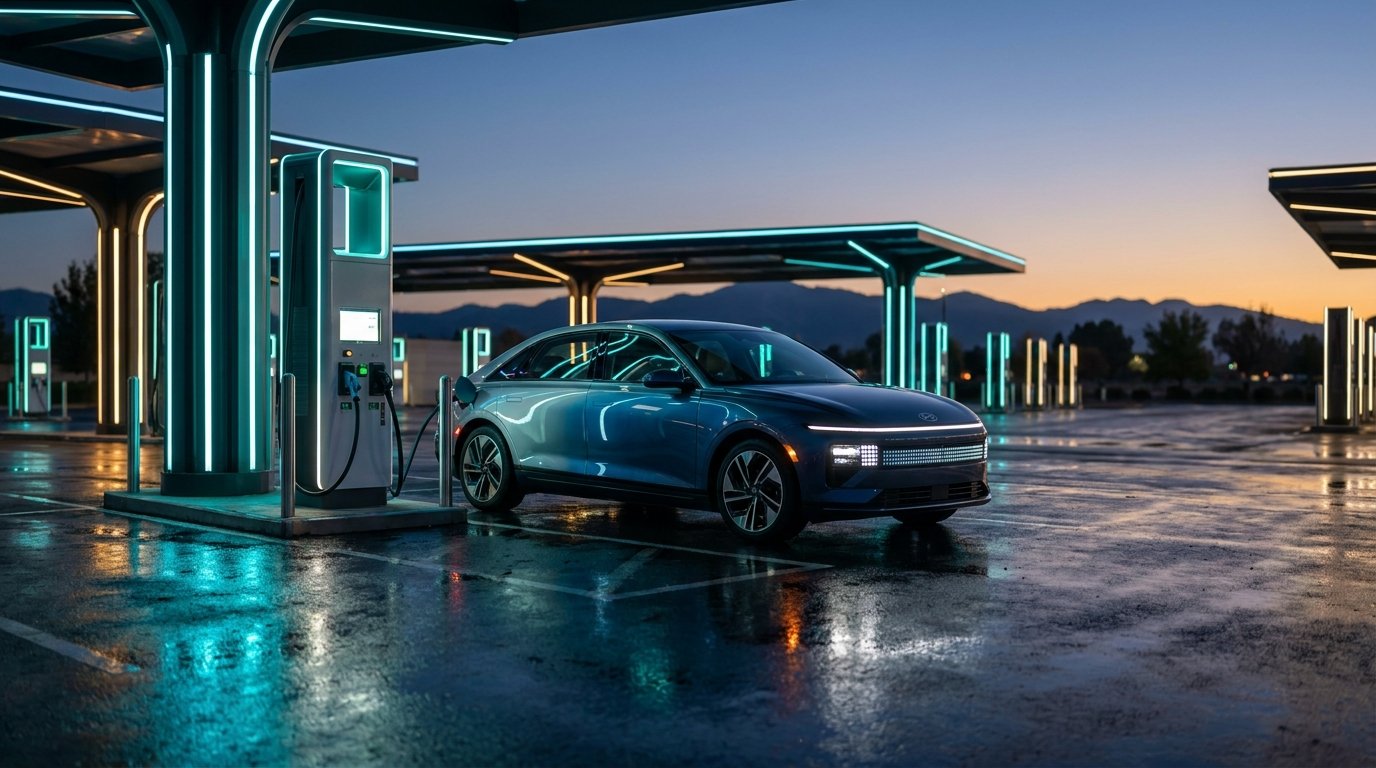
My neighbor Omar pulled into his driveway last November in a brand-new Hyundai Ioniq 6, and I’ll be honest — I was a little smug about it. I’d been driving an EV for three years by then, and I figured he was just catching up. Then he showed me the charging receipt from a road trip he’d just done.
Islamabad to Lahore. One stop. Eighteen minutes.
That’s when it clicked for me that the EV conversation in 2026 isn’t the same one we were having in 2022 or even 2024. The tech genuinely moved. Not in a “press release” kind of way — in a “I’m watching my neighbor refuel faster than a gas station” kind of way.
So if you’re shopping for an electric car this year, or just trying to figure out which ones are actually worth your money, here’s what I’ve found after months of real-world tests, owner conversations, and time behind the wheels of several of these myself.
The Big Shift Nobody Talks About: It’s Charging Now, Not Range
A few years ago, the only question anyone asked about EVs was: how far does it go? And that made sense. Nobody wants to get stranded.
But in 2026, most mainstream EVs clear 300 miles of EPA range without breaking a sweat. The ones worth buying clear 350+. So the question has changed. Now it’s: how fast does it charge, and how reliable is the network when you actually need it?
This matters more than it sounds. A car with 400 miles of range but slow charging can lose on a road trip to a car with 300 miles but blazing-fast charging. You do the math and the 300-mile car wins on total trip time — because you’re spending 15 minutes at a charger instead of 45.
Keep that in mind as you go through this list.
The Top Electric Cars of 2026
Pick #1 — Best Overall
Hyundai Ioniq 6 Long Range RWD
“The one most people should buy”
- EPA Range: 361 miles
- 10–80% Charge: ~18 min
- Architecture: 800V
- Drag Coefficient: Cd 0.21
I keep coming back to this one. It’s not the flashiest car on this list, and it doesn’t have the name recognition of a Tesla — but the numbers it puts up in real-world conditions are hard to argue with.
The 800-volt architecture means a 10-to-80% charge in about 18 minutes on a 350 kW fast charger. That’s the spec that changes how road trips actually feel. And the aerodynamics are genuinely impressive — a drag coefficient of 0.21 puts it alongside purpose-built efficiency machines. The result: the Ioniq 6 tends to beat its EPA number in real-world highway driving at 70 mph, which almost no EV does.
The interior is polarizing. Some love the clean, spare design. Others find it cold. The back seat is surprisingly roomy for a car with this silhouette. One gripe: the touchscreen can be sluggish in cold weather. Not a dealbreaker, but worth knowing before you buy.
✓ Best For: Drivers who want maximum real-world efficiency and the fastest mainstream charging experience without paying luxury prices.
⚠ Watch Out For: Make sure your regular routes have 350 kW chargers. The speed advantage disappears on older 50 kW stations.
Pick #2 — Editor’s Favourite
Rivian R3S
“The one I’d actually buy”
- EPA Range (Max Pack): 385 miles
- 0–60 mph: 3.0 sec
- Starting Price: ~$45,000
This is the car I keep thinking about at midnight. Rivian built a compact crossover that handles like it has opinions. The R3S gets up to 385 miles of range on the Max Pack, hits 0–60 in 3.0 seconds in Performance trim, and runs Rivian’s now-legendary software — genuinely one of the best interfaces in any car on the market.
But what doesn’t show up on a spec sheet is how fun it is. Most efficient EVs feel dutiful. The R3S feels like it actually wants to be on the road. The suspension is tuned for feedback without punishing bad pavement, which matters a lot depending on where you live.
One owner I talked to drove it from San Francisco to a Sierra Nevada campsite — dirt roads, loaded with gear, 90°F heat — and said the range prediction barely moved from its estimate the entire trip. That kind of real-world consistency is rarer than you’d think.
✓ Best For: People who want practicality and genuine driving enjoyment in the same package.
⚠ Watch Out For: Rivian’s service network is still growing. If you’re far from a major city, check your nearest service center before committing.
Pick #3 — Best Value
Chevrolet Equinox EV
“The one that changes the math”
- EPA Range: ~300 miles
- Starting Price: $34,995
- Charging Port: NACS
At $34,995, the Equinox EV is proving something important: decent electric cars don’t have to cost $50,000.
It’s a comfortable, practical, five-seat SUV that a normal family can actually afford. It’s not the fastest to charge and it won’t win any drag races — but it has NACS port compatibility, which means full access to Tesla’s Supercharger network. That’s 185,000+ public charging ports across North America and growing.
There’s a version of the EV conversation that ignores how most people actually use cars. They drive to work. They grocery shop. They take one road trip a year, maybe. For that use case, the Equinox EV is quietly excellent — and the Ioniq 6 or R3S is honestly overkill.
✓ Best For: Families who want a straightforward, affordable EV without compromises on passenger space.
⚠ Watch Out For: The federal $7,500 tax credit expired September 2025. Check state-level incentives — California, Colorado, and Oregon still offer $2,000–$7,500 for qualifying buyers.
Pick #4 — Best Premium Compact
Mercedes-Benz CLA 250+
“The one that rewrote the premium playbook”
- WLTP Range: 792 km
- Real-World Range: ~600 km
- Peak Charging: 320 kW
- 10–80% Charge: 22 min
- Starting Price: From €52,900
Car of the Year 2026 from the European jury. And it’s not hard to see why.
The 320 kW charging speed isn’t a typo. The CLA runs 800-volt architecture that puts it in the same league as Porsche and Hyundai-Kia — formerly the only brands doing high-voltage this well. The interior is beautiful in a way that feels earned rather than performative. Clean lines, proper materials, nothing plastic-y pretending to be something expensive.
The MMA platform it rides on is new for 2026 and the driving dynamics show it — the CLA feels genuinely sorted in a way that earlier electric Mercedes products didn’t always. One honest criticism: the infotainment software still has quirks. Better than before, but not quite as intuitive as Rivian or Tesla. Minor annoyance on a long list of strengths.
✓ Best For: Buyers who want a compact luxury EV that’s actually good at being an EV — not just a prestige badge on an electrified platform.
⚠ Watch Out For: Real-world range drops noticeably in cold weather. Budget 15–20% less than the official figure in winter months.
Pick #5 — Best for Drivers
Porsche Taycan GTS
“The one for people who actually drive”
- Power (Launch Control): 700 hp
- WLTP Range: 628 km
- Battery: 105 kWh
- Starting Price: ~€105,000
Every time I read someone dismissing the Taycan as “just an expensive EV,” I assume they haven’t driven one.
The GTS puts out 700 hp in Launch Control mode. It has adaptive air suspension, rear-wheel steering, and a Push-to-Pass function borrowed from Formula E — 93 extra hp for 10-second bursts. The 105 kWh battery delivers 628 km WLTP range, with real-world consumption around 25 kWh/100 km in mixed driving.
But none of that is really the point. The point is that the Taycan has steering feel. Actual feedback through the wheel. The brake pedal is calibrated. The car communicates what it’s doing in a way that most electric cars — including very fast ones — simply don’t. It’s not a track toy that tolerates daily life. It’s a daily driver that happens to be extraordinary on a track.
✓ Best For: Driving enthusiasts who want an electric car that feels like a car — not a fast appliance.
⚠ Watch Out For: European charging network still lags behind North American Supercharger coverage. Plan road trips with the Porsche Chargecheck app or ABRP.
Pick #6 — Longest Range
Lucid Air Grand Touring
“The one that still holds the range record”
- Real-World Range: ~645 km
- Pure Trim — EPA: ~385 miles
- Pure Trim Price: $69,900
The Lucid Air has quietly held the range crown since 2022, and nothing in 2026 has taken it from them. The Grand Touring gets around 645 km of real-world range. Even the entry-level Pure trim hits roughly 385 miles EPA — making it the longest-range car you can buy at a price that isn’t fully absurd.
It’s also genuinely big on the inside despite being car-shaped on the outside. Lucid’s packaging efficiency is almost uncanny — there’s more rear legroom than some SUVs. The driving character is serene rather than sporty, which is exactly right for a car designed around long-distance comfort.
The honest elephant in the room: Lucid’s service and dealer network is still thin. Ownership is smooth until something goes wrong — at which point you may wait longer than you’d like. That’s a real consideration and not one worth glossing over.
✓ Best For: Long-distance drivers who prioritise maximum range and don’t live too far from a major metro service centre.
⚠ Watch Out For: Service network is still limited compared to Tesla, Hyundai, or Chevrolet. Factor that into your ownership plan.
5 Mistakes to Avoid When Buying an EV in 2026
I’ve talked to enough first-time EV buyers to know exactly where things go sideways. These are the ones that keep coming up.
- Only looking at EPA range: Real-world range varies by 10–30% depending on speed, temperature, and driving habits. Always find independent highway tests, not just manufacturer claims — they’re wildly optimistic on purpose.
- Ignoring charging on your actual routes: A fast car with chargers only in cities is useless if you regularly drive rural roads. Apps like PlugShare and ABRP let you plan routes based on real charging locations and actual speeds — use them before you buy, not after.
- Forgetting the hidden ownership costs: Insurance for EVs runs 10–20% higher than comparable gas vehicles. Home charger installation costs $800–$1,500 including an electrician. Factor these in before deciding the math works in your favour.
- Assuming the federal tax credit still applies: It doesn’t — not since September 2025. State-level credits vary widely. California, Colorado, and Oregon still offer $2,000–$7,500 for qualifying buyers. Worth checking before you finalise a budget.
- Skipping cold weather research: AAA testing shows 20–30% range loss below -7°C. If you live somewhere with real winters, you need a car with 350+ miles EPA to have comfortable range in January. Budget accordingly.
A Quick Word on the Charging Network in 2026
NACS — the connector Tesla used to keep proprietary — is now standard on Ford, GM, Honda, and Nissan vehicles. That means most new EVs can access Tesla’s Supercharger network, which remains the most reliable fast-charging option in North America by a significant margin.
“Charging anxiety” was real in 2022 because the non-Tesla network was genuinely unreliable — chargers offline, slow speeds, bad placement. That’s improved substantially. But Tesla’s network is still your best bet for chargers that actually work, consistently, on a road trip.
Over 185,000 public charging ports are now operational across North America. For most buyers doing most routes, charging logistics are no longer the headache they once were.
Where Things Actually Stand
2026 is a genuinely good time to buy an electric car in a way that 2022 wasn’t quite. The range anxiety is largely solved if you buy something with 300+ miles. The charging network is functional for road trips in ways it wasn’t three years ago. The tech is real, not just a spec sheet.
The remaining friction is cold weather performance, thin service networks for some newer brands, and upfront cost for the good ones. None of those are trivial. But the ceiling has risen dramatically, and the floor has risen too — even the affordable options are genuinely capable now.
If I had to send someone to a dealership today with $45,000 to spend, I’d tell them to drive the Rivian R3S first, then the Ioniq 6, and pick whichever one made them feel something. Both are genuinely impressive cars in ways that would’ve seemed optimistic just three years ago.
Omar, by the way, traded the Ioniq 6 for an R3S four months later. Says the range anxiety is about the same. The smile is different.
All prices and specs reflect available 2026 model year data. Range figures based on real-world independent tests where available, EPA estimates otherwise. Specs subject to change by manufacturer. Article published May 2026.