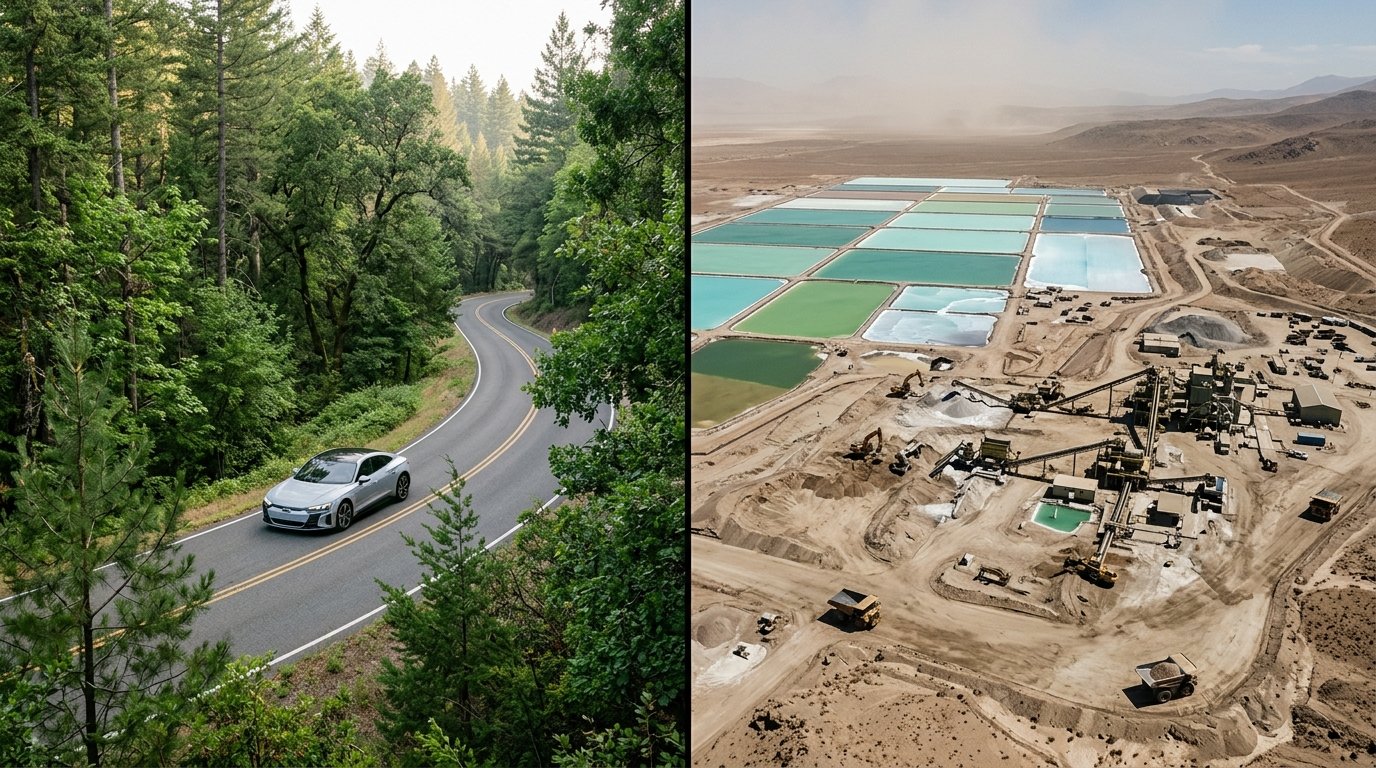
A colleague of mine bought a Hyundai Ioniq 6 last year. Within a week, someone in his office told him it was “worse for the environment than a petrol car because of the batteries.” He came to me genuinely unsettled, wondering if he’d made a mistake.
I didn’t have a clean answer on the spot. So I spent the better part of a month actually looking into it — reading lifecycle analyses, talking to owners, digging into grid data, and trying to get past both the EV marketing and the anti-EV contrarianism that fills comment sections.
What I found wasn’t the simple “yes, obviously green” story the ads sell. It also wasn’t the “EVs are secretly dirty” story the skeptics love. The real picture is more specific than either camp usually admits — and a lot more useful once you actually understand it.
50–70%
Lower lifetime emissions vs petrol (ICCT data)
6–16t
CO₂ equivalent from battery manufacturing
1.5–3 yrs
Average carbon breakeven at 15,000 km/year
The question itself needs to be more precise
“Are electric cars eco-friendly?” is a bit like asking “is a diet healthy?” The answer completely depends on what you’re eating, how much, and what you’re comparing it to.
For EVs, the relevant questions are: eco-friendly compared to what? Over what timeframe? In what country? With what electricity source? Manufactured where? Every one of those variables changes the answer.
The people saying EVs are dirty are usually picking the worst-case combination of those variables. The people saying EVs are clean are usually picking the best-case. The truth sits in the middle — and the middle is actually quite good for EVs in most realistic scenarios.
The manufacturing problem is real — just not fatal
Making an EV battery is carbon-intensive. Lithium has to be mined from brine pools or hard rock deposits in Chile, Australia, and China. Cobalt comes primarily from the DRC, where mining conditions are a whole separate ethical problem. Nickel refining is energy-heavy. Before an EV drives a single kilometer, its battery has already generated somewhere between 6 and 16 tonnes of CO₂ equivalent, depending on battery size and where it was manufactured.
That’s real. It’s not propaganda. And it means an EV starts its life with a carbon debt that a petrol car doesn’t carry to the same degree.
How fast does the car pay back that debt?
The ICCT has done the most thorough lifecycle analyses available. Across Europe, the US, China, and India, they consistently find EVs producing 50–70% lower lifetime emissions than petrol cars — even accounting for manufacturing. The breakeven point typically falls between 20,000 and 50,000 km depending on grid mix and battery size.
For someone driving 15,000 km a year, that’s 1.5 to 3 years. After that, every kilometer driven is cleaner than the petrol alternative — by a widening margin as the grid gets cleaner.
The person who told my colleague his Ioniq 6 was dirty was applying a real concern (manufacturing emissions) selectively and ignoring the other 95% of the vehicle’s life. That’s not analysis — it’s cherry-picking.
The grid is the biggest variable most people underestimate
An EV charged entirely on coal-generated electricity is not a clean vehicle. Its operational emissions are lower than a petrol car in most comparisons, but the gap is much smaller than it would be on a cleaner grid. In coal-heavy regions, the lifecycle numbers are noticeably less impressive.
Clean grid examples
France (~70% nuclear), Norway (~98% hydro), UK (near-zero coal). EVs here operate with some of the lowest lifecycle emissions possible.
Mixed grid examples
Pakistan (gas + hydro mix), India (coal + growing renewables), Poland (coal-heavy). EVs still outperform petrol, but the gap narrows considerably.
The part that consistently gets missed: an EV bought today gets progressively cleaner over its 10-year life as grids add more renewable capacity. A petrol car bought today emits roughly the same carbon in 2034 as it does now. That asymmetry matters enormously in a long-term comparison and almost never comes up in these debates.
The US Department of Energy’s AFDC emissions calculator lets you enter your zip code and see estimated EV emissions vs a petrol car on your local grid. For other markets, your national energy ministry typically publishes grid emissions intensity in grams of CO₂ per kWh.
Mining and supply chains: the part I found hardest to dismiss
Battery manufacturing isn’t just a carbon problem. It’s a resource problem.
Lithium extraction in the Atacama Desert uses enormous amounts of water in one of the driest places on Earth. Local communities have raised documented concerns about water table impacts. Cobalt mining in the DRC has well-known child labor and safety problems. The EV industry has known about both for years.
Is it getting better?
Progress is being made. Battery chemistry is shifting toward lower-cobalt and cobalt-free formulations. LFP (lithium iron phosphate) batteries — used extensively by BYD and increasingly by Tesla — contain no cobalt at all and use more abundant materials. That’s a real improvement. It hasn’t been fast enough or consistent enough across the industry to fully dismiss the concern, but the direction is right.
A genuinely honest eco-friendliness assessment has to include supply chain impacts, not just tailpipe emissions and grid calculations. Clean driving at the use stage doesn’t automatically mean clean production.
Air quality: the dimension that often gets skipped
Carbon gets most of the attention, but there’s another environmental dimension where EVs win clearly and immediately: local air quality.
Petrol and diesel combustion produces nitrogen oxides, particulate matter, and carbon monoxide at street level — near schools, hospitals, and in neighborhoods where people actually breathe. EVs produce none of these at the tailpipe. In cities that have shifted significant portions of their fleets to electric — Shenzhen, Oslo, parts of Los Angeles — roadside air quality measurements have improved measurably.
This is separate from climate impact, and it’s immediate and local rather than gradual and global. If you live near a busy road in a dense city, the people around you breathe differently depending on what percentage of that traffic is electric. That matters whether or not you care about CO₂.
Battery end-of-life: better than the narrative suggests
The “EV batteries end up in landfills” story is mostly wrong in 2026, at least for the major manufacturers.
Battery recycling infrastructure has developed significantly. Companies like Redwood Materials — founded by Tesla’s former chief battery engineer — are recycling lithium, cobalt, and nickel from used EV batteries at commercial scale. In Europe, regulations now require manufacturers to take back batteries and meet recycling targets. BYD and other Chinese manufacturers have invested heavily in battery second-life programs, where batteries below 80% capacity for driving are repurposed as stationary storage before eventual materials recovery.
It’s not perfect. Not every battery gets recycled properly. The infrastructure is still scaling globally. But the “millions of batteries in landfills” scenario doesn’t match what’s actually happening with cars from mainstream manufacturers.
How to honestly assess your own EV’s eco-footprint
- 1Check your grid mix. Find out what percentage of your regional electricity comes from renewables vs fossil fuels. Your energy provider or national energy ministry usually publishes this. It’s the single biggest variable in your EV’s operational emissions and it changes year to year.
- 2Plan to keep the car long-term. The environmental math improves significantly with ownership duration. Three years: barely broken even on manufacturing emissions. Ten years: well ahead of any petrol equivalent. Buying an EV and trading it in after two years for the next model is the worst environmental outcome possible.
- 3Look at battery chemistry before buying. LFP batteries (BYD, some Tesla models) contain no cobalt and use more abundant materials. If supply chain ethics matter to you, this is a real distinguishing factor between models — not just a spec sheet detail.
- 4Think about charging source. If you can charge from rooftop solar even partially, lifecycle numbers improve significantly. If you’re charging 100% from a coal-heavy grid at midnight, be realistic about what that means. Smart scheduling and solar pairing close the gap considerably.
- 5Don’t judge the lifecycle by the manufacturing phase alone. Manufacturing emissions are real and worth knowing, but they’re a one-time event. Every year you drive the car, the operational advantage compounds in the EV’s favor — and grows larger as your grid gets cleaner.
Where the honest verdict lands
Where EVs clearly win
- 50–70% lower lifetime emissions (ICCT)
- Zero tailpipe pollution in cities
- Emission profile improves as grid cleans
- Battery recycling infrastructure growing
- LFP chemistry removes cobalt entirely
Real concerns that remain
- Battery manufacturing is carbon-heavy
- Lithium mining stresses water resources
- Cobalt supply chain still problematic
- Coal-heavy grids shrink the benefit
- Recycling infrastructure still scaling
My colleague’s Ioniq 6, assuming he keeps it 8–10 years, will almost certainly come out well ahead of the petrol car he replaced. “Not perfect” and “worse than petrol” are not the same thing.
The honest bottom line
Electric cars are cleaner than petrol cars in most situations — measurably, not marginally — when you look at the full lifecycle and don’t selectively pick which phase of the car’s life to analyze. The manufacturing problem is real but finite. The operational advantage compounds over years. The grid gets cleaner whether you do anything about it or not.
The supply chain issues around lithium and cobalt are genuine and not fully resolved. They deserve attention and accountability from manufacturers. But they don’t flip the environmental equation. They’re problems being worked on inside an industry that, on balance, produces vehicles with a substantially better lifetime carbon profile than what they replaced.
That’s not a marketing line. It’s what the numbers say when you look at all of them — including the uncomfortable ones.