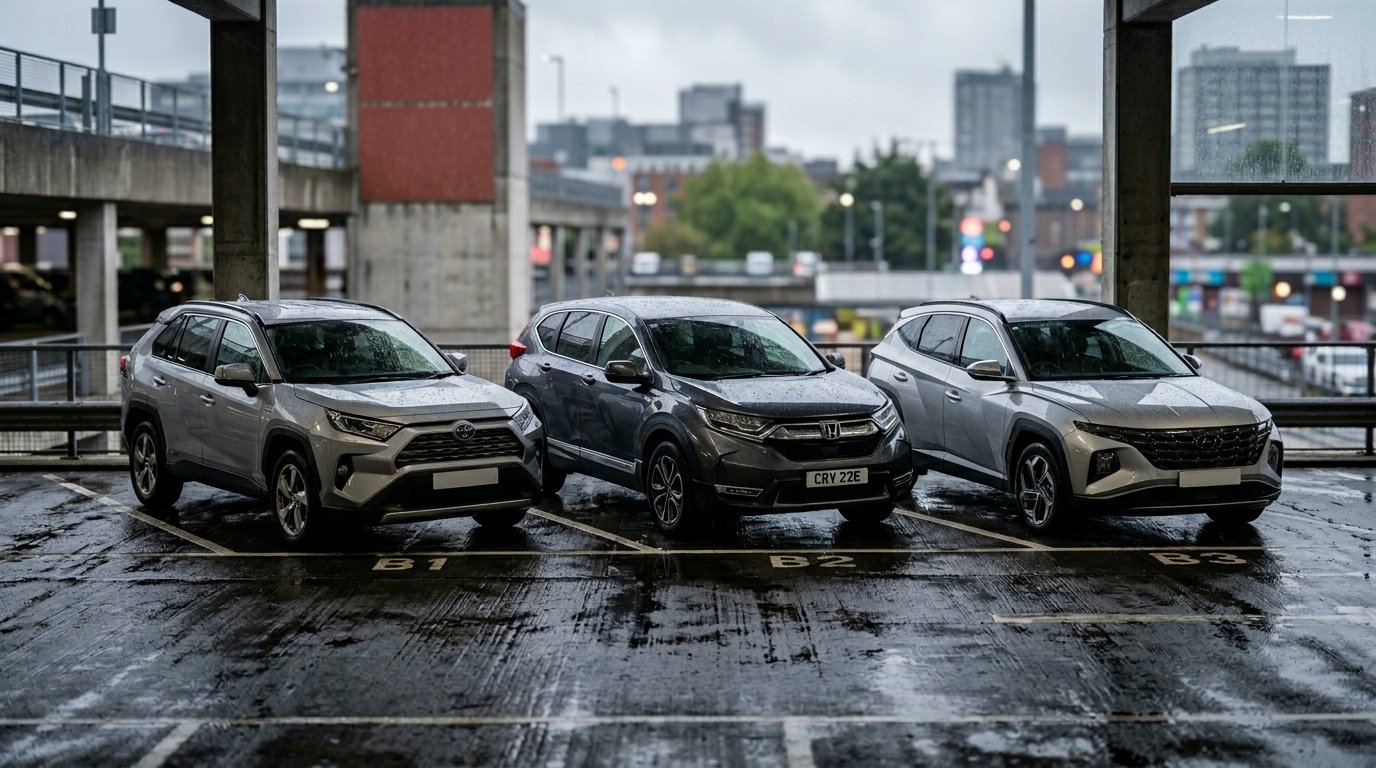
My cousin called me on a Wednesday evening last October, in what I can only describe as full panic mode. She’d just test-driven a Toyota RAV4 Hybrid, loved it, then walked into a Hyundai dealership on the way home and driven a Tucson Hybrid, loved that too. Now she was standing in a car park somewhere in Bristol, completely unable to decide. “They both feel amazing,” she said. “Which one do I actually buy?” She’d stumbled into the same question everyone asks when shopping for the best hybrid cars in 2026.
I told her I’d call her back.
That conversation is basically what this article is. I’ve driven all three of the main contenders — Toyota, Honda, Hyundai — over the past two years, some on loan, one belonging to a friend, one I rented for a week on a job. None of them are bad. That’s the frustrating part. The best hybrid cars in 2026 are all genuinely competent, which makes choosing between them harder than it sounds. If you’re still deciding whether a hybrid is even the right call versus going full electric, I covered that decision in detail in the EV vs petrol comparison — worth reading first if you’re not sure which direction to go.
Toyota: The One You Buy When You Want to Stop Thinking About It
I spent a week with a 2026 RAV4 Hybrid in February. Redesigned for this year — new exterior, updated interior, same basic hybrid system underneath that Toyota has been refining since 1997. And that’s kind of the point.
Toyota’s hybrid setup is two electric motors, a petrol engine, and a transmission with no gears in the traditional sense. It’s complicated to explain but dead simple to live with. You get in, you drive, you get 39 mpg on a mixed run. The car figures the rest out. There’s no drama, no hunting for the right mode, no moment where the engine kicks in and startles you.
The RAV4 Hybrid starts around £43,000 in the UK, which is more than it used to be. The Camry — now standard hybrid only in the US — starts at $30,295 and gets 51 mpg combined, which is remarkable for a midsize sedan. The Prius, if you want maximum efficiency, hits 57 mpg combined and still looks like something from a concept show three years ago.
What Toyota does better than anyone is reliability over time. This isn’t reputation protecting old data — AutoGuide’s 2026 hybrid analysis confirmed Toyota’s system still has fewer failure points than rival setups because it avoids the conventional gearbox entirely. Fewer parts. Less to go wrong.
The weakness? It’s not exciting. The RAV4 drives like a very competent appliance. The steering tells you almost nothing. Motorway noise is acceptable, not impressive. If you spend a lot of time on fast A-roads or enjoy the occasional corner, Toyota will feel like it’s processing your inputs rather than responding to them.
My cousin asked me if she’d regret it. I said no. That’s not a compliment exactly, but it’s not a criticism either. Some cars you just don’t regret, and Toyota hybrids are those cars.
Honda: The One That Actually Drives
A friend of mine has had a Honda CR-V Hybrid for eighteen months. He commutes 40 miles a day, does a long motorway run twice a month, and uses the car for weekend trips with two kids and a Labrador. He’s never mentioned it having a problem. He has mentioned, several times, that it’s the most comfortable car he’s owned since his old Accord.
Honda’s hybrid system works differently to Toyota’s. It’s primarily electric — the petrol engine mostly charges the battery and only drives the wheels directly at certain speeds, usually motorway cruising. In town, it feels like an EV. The transition between modes is smoother than any hybrid I’ve driven except maybe a Lexus. If you’re curious how hybrid battery longevity compares to full EVs, the EV battery lifespan guide has the real numbers on degradation over time.
When ranking the best hybrid cars of 2026, Honda’s Accord consistently sits at the top. The 2026 Accord Hybrid tops Kelley Blue Book’s best hybrid list with a 4.8 rating and 45 mpg combined. Starting at $34,990. For what it is — the amount of space, the ride quality, the standard safety kit — that’s reasonable money.
The CR-V Hybrid sits around £43,000 with decent standard equipment. In Car and Driver’s recent four-way hybrid SUV test — RAV4, CR-V, Forester, CX-50 — Honda came out with strong marks for interior refinement and powertrain smoothness. Power output was 204 horsepower, which puts it mid-pack, but the way it delivers that power felt more natural than some rivals producing similar numbers.
The thing most people don’t check before buying a Honda hybrid: direct injection. Honda uses it across their hybrid engines. Over time, and we’re talking 80,000+ miles, carbon can build up on intake valves. It doesn’t mean the engine fails — but it means you may eventually need a walnut blast clean, which costs a few hundred pounds and isn’t on most buyers’ radar when they’re comparing fuel economy figures on a forecourt.
Not a dealbreaker. Just worth knowing before you sign anything.
Hyundai: Better Than It Used to Be, But Not Quite There Yet
I’ll be straight with you: Hyundai’s hybrid system is the least efficient of the three on paper. The Tucson Hybrid won Best Compact Hybrid SUV at the 2026 U.S. News awards — its third consecutive title — and it deserves that recognition for overall package value. But the way the powertrain is built involves more moving parts than Toyota or Honda’s setup.
A single electric motor, a conventional automatic transmission, and on AWD versions, a mechanical rear axle rather than an electrically driven one. That mechanical AWD is fine for most driving. But it means more components under the car, and it contributes to fuel economy that’s slightly behind what Toyota achieves with simpler architecture.
The Tucson Hybrid starts around £35,000 in the UK, which makes it the most affordable of the three in this comparison. The interior is excellent for the money — better screens, more intuitive layout than Toyota’s updated but still slightly cluttered dashboard. Hyundai has put real effort into making the cabin feel more premium than the price suggests, and it shows.
I drove one for three days in March, mostly city and suburban roads. It was comfortable, quiet enough, easy to park. The regenerative braking felt more aggressive than I expected — you can dial it down with the paddles, but the default setting takes some adjustment if you’re coming from a conventional car or a Toyota hybrid.
Here’s the one thing I’d actually worry about: Hyundai’s hybrid engines, like Honda’s, use direct injection. Same carbon buildup risk over time. And their system’s additional complexity — the belt-driven starter-generator sits alongside the motor and transmission — means there are more potential failure points than Toyota’s setup. Not a certainty of problems. Just more things that could eventually need attention.
If you’re keeping a car for three years and moving on, that’s irrelevant. If you’re the type who runs a car to 150,000 miles, pay attention. And if a hybrid is your stepping stone toward eventually going fully electric, it’s worth knowing upfront what a home EV charger installation actually costs — so that decision doesn’t catch you off guard later.
The Question Nobody Asks When Buying the Best Hybrid Cars
Most people walk into a hybrid comparison thinking about mpg. Which is fair — fuel economy is the whole point. But the number on the sticker and the number you actually get can be very different things depending on how you drive.
Hybrids do their best work in slow, stop-start traffic. In city driving, a Toyota Camry or Hyundai Tucson can genuinely achieve close to their official figures because the electric motor takes over in the situations where petrol engines are least efficient. If you live in a city and do mostly short trips, any of these cars will exceed your expectations.
Motorway driving is different. At a steady 70 mph, the battery contribution drops sharply and you’re essentially running a smallish petrol engine. Real-world motorway economy tends to be 35-42 mpg for most hybrid SUVs — better than a comparable non-hybrid, but not the transformative numbers the official figures suggest.
So if you do a lot of motorway miles, the hybrid premium may not pay back quickly. Worth running the numbers on your actual commute before you commit. Tools like Fuelly let you look at real-world mpg data from actual owners of whichever model you’re considering — more useful than anything a brochure will tell you.
So What Did I Tell My Cousin?
I asked her three questions. How long are you keeping it? Mostly city or mostly motorway? Do you care whether it’s slightly boring to drive?
She said five years, mostly city, and no, she didn’t need it to be exciting.
I told her to buy the Toyota.
If she’d said she wanted something that felt more alive on a twisty road, I’d have said Honda. If she’d said budget was the main concern and three years was the plan, Hyundai would’ve been fine.
All three are among the best hybrid cars you can buy in 2026. None of them are wrong choices.. But they suit different people. Figure out which person you are before you let a salesperson figure it out for you. And if after reading all this you’re leaning toward skipping the hybrid entirely and going straight to electric, the best electric cars in 2026 guide covers the full EV side of that decision.
She bought the RAV4. Called me two weeks later to say she loved it. I resisted saying I told you so, which I think shows considerable restraint on my part.