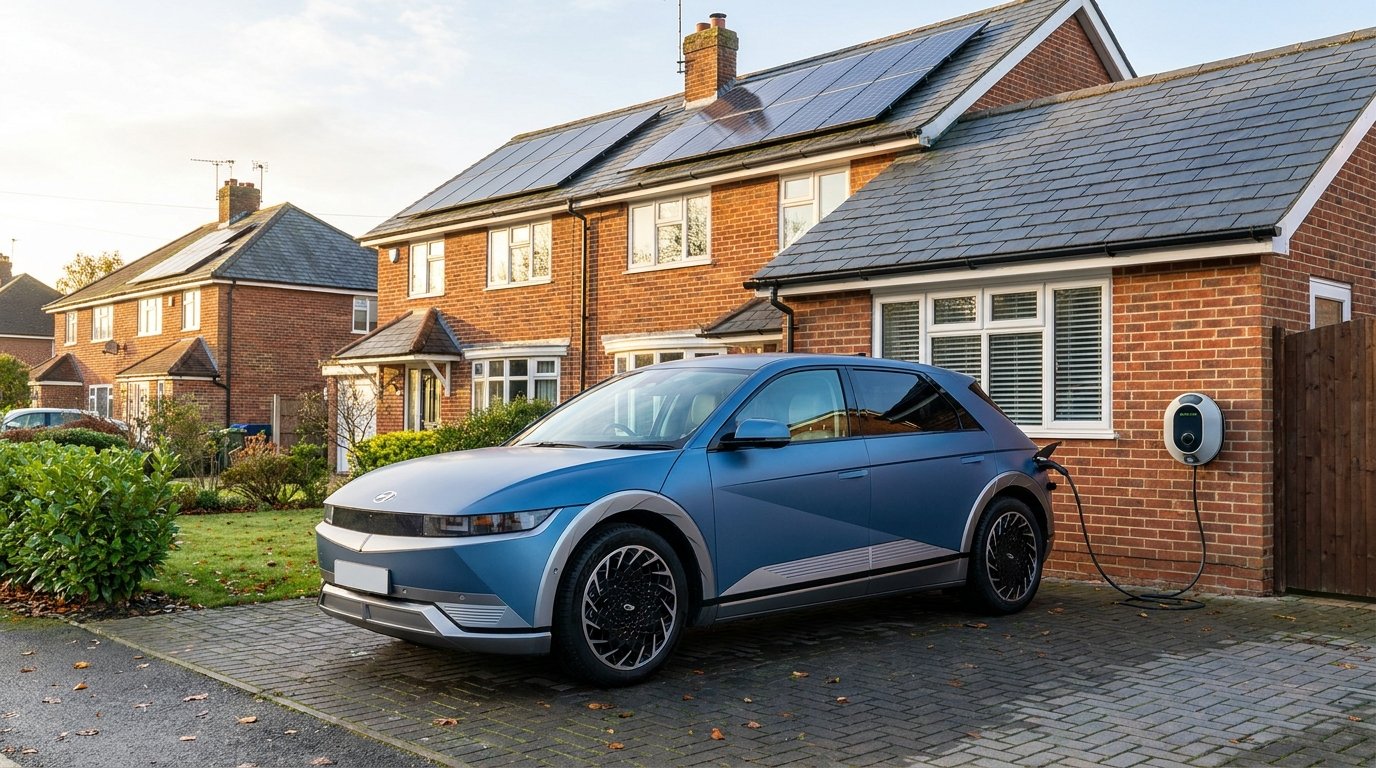
Thinking about charging EV with solar panels UK homeowners often wonder if the combination actually works or if it is just marketing hype. My uncle spent most of last year complaining about his electricity bill. To cut costs, he installed a solar PV array on his roof. But somewhere along the way, he also ended up with a BYD Dolphin sitting in his driveway—which he dutifully plugged into the grid every evening, apparently without ever connecting the two thoughts.
When I pointed out that he could charge the car directly from his own roof panels, he looked at me like I had suggested something exotic. “The panels run the house,” he said. “The car charges from the socket.”
He wasn’t technically wrong. But he was leaving a significant amount of money and clean energy on the table every single day. That conversation made me pay real attention to how renewable energy and EVs interact—not in theory, but in actual UK homes with real setups and winter energy bills.
They are not automatically paired—you have to connect them intentionally.
This is the one thing I wish someone had explained to me earlier: an EV does not automatically run on renewable energy just because you have solar panels. The connection between clean generation and clean driving doesn’t happen by default.
Most EVs charge overnight. Most UK solar arrays generate the bulk of their power between 9 am and 4 pm. Without a system bridging that gap—a home battery, a smart EV charger, or a time-of-use tariff—your car might be drawing carbon-heavy grid power at midnight while your solar system exported its power for pennies all afternoon.
Charging EV with Solar Panels UK: The 3 Ways It Comes Together
After speaking to dozens of UK EV owners with renewable setups, I noticed they all rely on one of three approaches. Each has a different cost, complexity, and payoff.
1. The Smart Tariff & Export (SEG) Approach
During the day, your panels export excess power to the grid. Your energy supplier pays you for this via a Smart Export Guarantee (SEG) rate (for example, Octopus Energy offers around 15p/kWh on their Outgoing tariff). At night, you utilise an off-peak EV tariff like Intelligent Octopus Go or OVO Charge Anytime to charge your car for as little as 7p to 8p/kWh. In the UK, this arbitrage is currently the most financially efficient method.
2. The Home Battery Approach
A system like a GivEnergy or Tesla Powerwall captures your solar generation during the day and stores it. That stored power is then released at night to run your home and charge your car. While this requires a high upfront investment, it effectively closes the loop. Your car literally runs on stored sunlight, drastically reducing your reliance on the National Grid.
3. The Schedule-Shifting Approach
If you work from home, simply park in the driveway during peak solar hours (10 am–3 pm) and plug in. A decent solar setup will push a meaningful charge directly into the vehicle’s battery. This costs absolutely nothing extra to implement, but it requires a lifestyle adjustment rather than a technological fix.
My uncle opted for the third approach. His Huawei FusionSolar app confirmed he was pushing 8–10 kWh into the car on most sunny weekday mornings—enough to cover about 30 to 40 miles. Since his daily commute is only 20 miles, the problem was essentially solved for free.
What a Practical UK Setup Looks Like, Step-by-Step
1. Understand your real daily driving. Do not base your infrastructure on your annual holiday to Cornwall. The average UK driver covers around 20–30 miles a day. That requires roughly 5–8 kWh of daily charging.
2. Size your solar setup for combined loads. Many homeowners design their solar systems for their pre-EV electricity usage, then add an electric car and wonder why their bills spike. In the UK, a standard 4kW to 5kW solar system can generate enough power in the summer to handle both average household use and daily EV charging.
3. Install a solar-compatible smart charger. Standard chargers draw a fixed current regardless of where the power is coming from. Smart chargers—like the Myenergi Zappi, Ohme ePod, or Hypervolt—can be configured to charge your car using only excess solar energy that would otherwise be exported to the grid. (Note: If you own a flat or rent your home, you may be eligible for the OZEV EV chargepoint grant, which provides up to £350 towards installation).
4. Switch to an EV-specific energy tariff. During the British winter, solar generation drops significantly. You need a safety net. Tariffs designed for EV owners ensure that when you do pull from the grid, you are paying a fraction of the standard variable rate.
5. Rely on data, not guesswork. Use monitoring tools. Whether it is your inverter’s portal, a smart meter display, or your vehicle’s companion app, tracking your real-time generation and consumption is the only way to fine-tune your schedules and confirm your actual savings.
Where People Go Wrong
- Treating solar and EVs as separate investments: I have seen households spend heavily on both, only to end up with a solar system sized for 2023 electricity use and a standard “dumb” charger that pulls expensive grid power at 6 pm. The systems actively work against each other.
- Over-investing in battery storage prematurely: Before spending £5,000 on a home battery, try schedule-shifting and switching to a smart overnight tariff. You can often shift 40–60% of your charging costs with zero additional hardware.
- Buying into V2G promises too early: Vehicle-to-Grid (V2G) technology is fascinating, and tariffs like Octopus Power Pack are beginning to emerge in the UK. However, hardware compatibility remains limited. Do not buy an EV specifically for V2G unless you have confirmed your local infrastructure and supplier fully support it right now.
The Honest Bottom Line
Pairing renewable energy with electric vehicles is a genuine, highly effective combination—but it requires intentional setup. You need the right charger, the correct timing, and a smart EV tariff.
Once those pieces are in place, the economics make undeniable sense. Start with schedule-shifting to prove the concept. Upgrade to a solar-aware smart charger. Then, revisit battery storage when the numbers stack up. This is a long-term infrastructure upgrade for your home, not a weekend project, but the savings compound every single year.