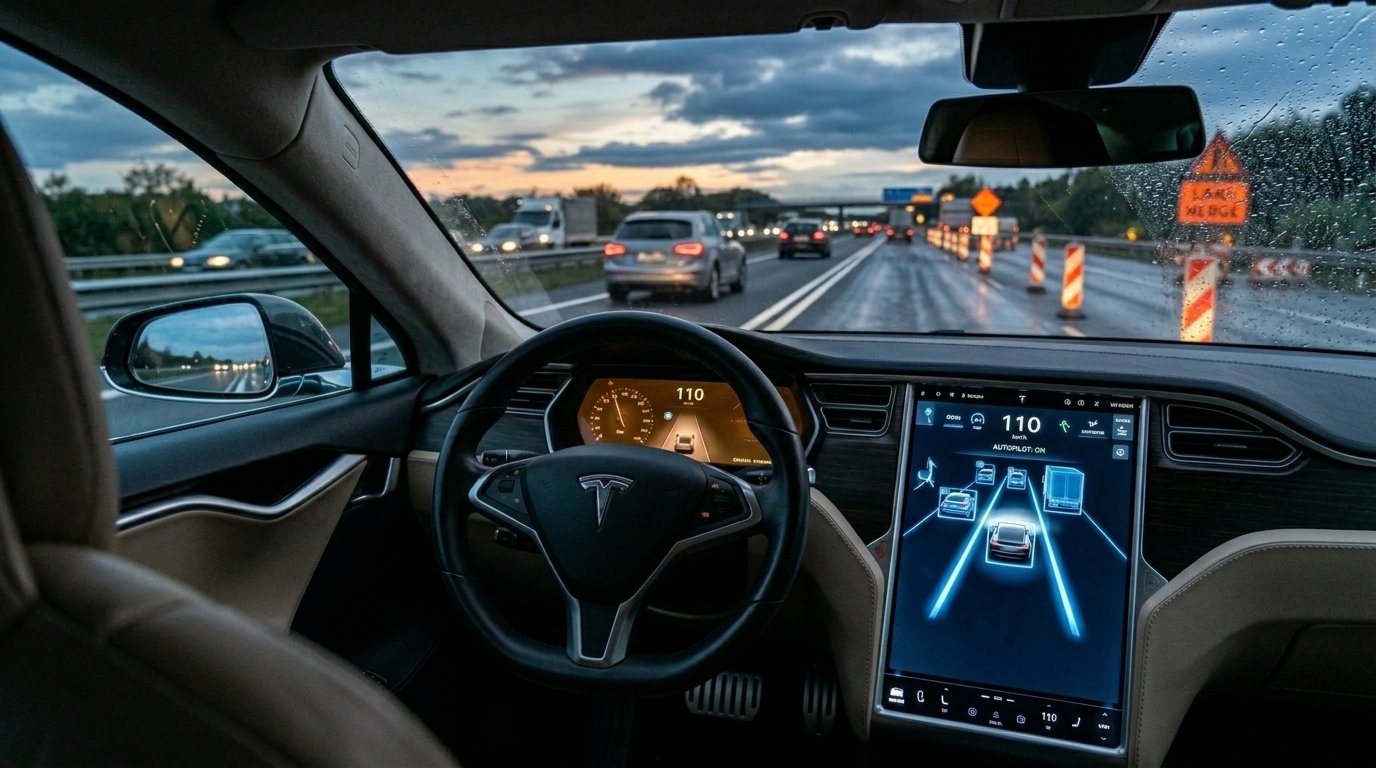
As of June 2026, Tesla Autopilot and standard ADAS (Advanced Driver Assistance Systems) are not the same thing — but they share one critical fact: neither lets you stop paying attention. Tesla Autopilot is a more capable Level 2 system that handles steering, acceleration, and braking simultaneously on UK motorways. Standard ADAS on most UK cars does one or two of those tasks at a time. In both cases, you remain legally responsible for the vehicle at all times under UK law.
Why This Confusion Is Costing UK Drivers
I picked up a hire car at Birmingham Airport last year — a Hyundai with lane-keeping assist and adaptive cruise control. The rental agent waved vaguely at the steering wheel stalk and said it “basically drives itself on the motorway.” I took that at face value. For about two hours.
Then we hit roadworks on the M6. Faded lane lines. Temporary cones. The lane-keep assist started hunting left and right like it was looking for something it couldn’t find. The wheel twitched. A lorry was passing on my right. I grabbed the wheel, cancelled everything, and said something I won’t repeat here.
The car wasn’t driving itself. It was helping — in conditions it was designed for. The moment things got messy, it handed control back to me without warning. That’s ADAS. And it’s nothing like what most people picture when they hear “Tesla Autopilot.” Understanding the difference matters before you’re doing 60mph on the M1 and find out the hard way.
What ADAS Actually Is on UK Cars
ADAS stands for Advanced Driver Assistance Systems. It’s not one feature — it’s a collection of separate systems that assist you with specific tasks while you remain in full control of the vehicle.
The ones you’ll find on most new UK cars in 2026:
- Adaptive cruise control — maintains a set gap to the vehicle ahead, adjusting speed automatically.
- Lane-keeping assist — nudges you back toward the centre of the lane if you drift without indicating.
- Automatic emergency braking (AEB) — applies the brakes if a collision is detected and you haven’t reacted.
- Blind spot monitoring — warns you when a vehicle is in your blind spot during a lane change.
- Rear cross-traffic alert — detects moving vehicles when reversing out of a parking space.
Euro NCAP now includes ADAS performance in its safety ratings, which means most new cars sold in the UK carry some version of these features as standard. What varies enormously is how well each manufacturer implements them — and that variation matters far more than most buyers realise. For a broader look at how these systems fit into modern vehicles, see our smart car technology guides.
Why ADAS Behaves Differently Across UK Car Brands
Every manufacturer calibrates these systems differently, and the gap between the best and worst implementations is significant. The Hyundai Ioniq 6’s Highway Driving Assist 2 keeps lane position well on motorways and transitions smoothly between speeds. The Vauxhall Astra Electric’s lane assist is noticeably more hesitant, applying corrections with less confidence on curves. The Volkswagen ID.3’s system sits somewhere between the two.
You cannot assume ADAS works the same way across brands, or even across different trim levels from the same manufacturer. A base-spec model may have AEB but not lane-centering. A higher trim may add adaptive cruise but calibrate it more aggressively than you’d expect. The only reliable way to know how a specific car’s ADAS behaves is to test it — ideally on the type of road you actually drive, not just a clear A-road on a dry afternoon.
What Tesla Autopilot Actually Does on UK Roads
Tesla Autopilot — included as standard on every new Tesla sold in the UK — combines adaptive cruise control and lane-centering into a single system that operates simultaneously. On a clear UK motorway, it steers, accelerates, and brakes without you touching the controls. That’s the meaningful difference from standard ADAS: it handles the whole task of motorway driving at once, rather than assisting with one element at a time.
I’ve used Autopilot on the M40 between London and Birmingham several times. On clear stretches with good lane markings, it’s genuinely impressive — smooth, confident, and less fatiguing than manual driving on a long run. The car maintains its position in the lane, manages gaps to vehicles ahead, and slows correctly for exits when Navigate on Autopilot is active.
Tesla also offers Enhanced Autopilot as an optional upgrade (£3,400 as of June 2026), which adds automatic lane changes, motorway navigation between junctions, and self-parking. Full Self-Driving as sold in the US is not available as a separate purchase in the UK — Tesla’s UK lineup bundles features differently to the American market.
Where Tesla Autopilot Struggles on UK Roads Specifically
UK roads present specific problems that US-focused testing doesn’t always capture. Narrower motorway lanes during roadworks, smart motorway variable speed limits, roundabouts, and rural A-roads with worn or absent lane markings all push Autopilot outside its comfort zone.
Phantom braking is real and worth knowing about before you experience it at 70mph. Autopilot occasionally applies sudden, sharp braking for overpass shadows, debris on the road edge, or stationary vehicles on the hard shoulder that the system interprets as a threat. It happens infrequently on clear motorways but often enough on complex routes that you need to stay engaged. I’ve had it brake hard twice in the last six months — once near a motorway gantry, once approaching a narrow bridge on an A-road outside Oxford.
Roadworks remain the most consistent failure point. The temporary lane markings conflict with the underlying painted lines, cones move between visits, and the system reverts to a cautious shuffle that requires you to take over or accept unusually slow progress.
Tesla Autopilot vs ADAS: UK System Comparison 2026
| System | Car | Hands-Free Motorway | Lane Changing | Eye Tracking | UK Legal Status | Cost |
|---|---|---|---|---|---|---|
| Tesla Autopilot | All Tesla models | Yes (supervised) | Manual signal only | No (cabin camera optional) | Level 2 — driver responsible | Standard (included) |
| Tesla Enhanced Autopilot | All Tesla models | Yes + auto lane change | Automatic on motorways | No | Level 2 — driver responsible | £3,400 upgrade |
| Ford BlueCruise | Mustang Mach-E, Kuga PHEV | Yes — mapped motorways | No | Yes — infrared camera | Level 2 — driver responsible | £17.99/month or included on select trims |
| Mercedes Drive Pilot | EQS, S-Class | Yes — up to 37mph, approved motorways | No | Yes | Level 3 — manufacturer liable at approved speeds | Included on qualifying trims |
| Hyundai HDA2 | Ioniq 6, Ioniq 5 | Yes (supervised) | Semi-automatic | Yes — driver attention warning | Level 2 — driver responsible | Included on Long Range trims |
| Standard ADAS | Most new UK cars | No — individual features only | No | Varies | Level 1/2 — driver responsible | Usually standard |
Pricing as of June 2026. Mercedes Drive Pilot Level 3 approval covers specific UK motorways only — verify current DVSA approvals before use. Ford BlueCruise subscription pricing subject to change.
Where Both Systems Fail UK Drivers
Roadworks: The Reliable Failure Point
Every ADAS system and every advanced driver assistance setup struggles with UK roadworks. Temporary lane markings contradict permanent ones. Cones change position between passes. Speed limits on overhead gantries change faster than some systems update. Tesla Autopilot disengages or requires intervention more frequently in roadworks than on open motorways. Standard ADAS lane-keeping often gives up entirely and alerts the driver to take over. This is expected behaviour — not a malfunction — but it catches out drivers who’ve grown accustomed to the system working without interruption.
Over-Trusting the System Too Quickly
The most common mistake I see in UK owner forums: someone uses Autopilot or lane-keeping on a clear sunny day, it works flawlessly, and they start treating it like a chauffeur. Then rain happens. Or they hit the M25 at dusk with low sun directly on the forward cameras. Or they encounter the A-road lane markings outside any major city that haven’t been repainted since 2019.
ADAS and Autopilot fail silently in degraded conditions. The system doesn’t always tell you it’s struggling — it just becomes less reliable. Keeping hands lightly on the wheel and eyes on the road isn’t paranoia. It’s how these systems are legally required to be used and the only way to catch a disengagement before it becomes a problem.
The Mental Load of Supervising
Nobody talks about this enough. Using Tesla’s Enhanced Autopilot on a complex route is more mentally tiring than simply driving. You’re watching the road, monitoring what the car “thinks” it can see on the screen, keeping your hands hovering near the wheel, and predicting where the system might get it wrong next. That’s supervision of a system that’s good but not infallible — which is a specific and exhausting cognitive task.
For genuinely long, clear motorway runs — Leeds to London on the M1 on a clear Wednesday afternoon — Autopilot meaningfully reduces fatigue. For complex routes with roundabouts, A-roads, and variable conditions, standard ADAS with you actively driving is often less stressful.
Real UK Road Test: M6 Roadworks vs Open Motorway
I ran back-to-back tests on the M6 between junctions 16 and 20 — first on a clear Saturday morning, then through a contraflow section on a wet Tuesday. The difference was significant.
On the clear run, Tesla Autopilot handled the full 28-mile stretch without intervention. Lane position was accurate, speed management through the variable limits under the gantries was correct, and the car tracked well through gentle curves. I touched the wheel twice in 28 miles, both times unnecessarily.
Through the contraflow, I took manual control within four minutes. The temporary lane markings were faded and partially covered by tyre rubber. Autopilot was hunting across the lane width and braked sharply once for a cone placed closer to the live lane than expected. In that scenario, standard manual driving with AEB as a backup is the safer approach — and the car’s own disengagement prompts confirmed it.
That’s the honest picture. Same car, same route, different conditions — and two completely different experiences of what the system is capable of.
Frequently Asked Questions
Q: Is Tesla Autopilot legal to use on UK motorways?
A: Yes. Tesla Autopilot is legal on UK motorways as a Level 2 driver assistance system. The driver must remain attentive and ready to take control at all times. Under UK law, the driver is legally responsible for the vehicle while Autopilot is active — Tesla is not. This will change only if and when a specific vehicle receives Level 3 approval under the Automated Vehicles Act 2024, which Tesla has not yet received.
Q: What’s the difference between Tesla Autopilot and Full Self-Driving in the UK?
A: Tesla’s Full Self-Driving (FSD) package as sold in the US is not available as a separate purchase in the UK. Tesla sells standard Autopilot (included) and Enhanced Autopilot (£3,400 upgrade) in Britain. Enhanced Autopilot adds automatic lane changes and motorway navigation. Neither is self-driving — both require an attentive driver under UK law.
Q: Is Ford BlueCruise better than Tesla Autopilot for UK drivers?
A: They’re designed differently. BlueCruise uses an infrared eye-tracking camera to confirm driver attention and allows genuinely hands-free motorway driving on approved mapped roads — which is legally clearer than Autopilot’s wheel-pressure monitoring. Tesla Autopilot works on a wider range of roads but requires more active engagement. If you drive mainly on major UK motorways and want hands-free operation with clear legal boundaries, BlueCruise is the more straightforward choice. For flexibility across road types, Autopilot covers more ground.
Q: Which ADAS system is best for UK winter driving?
A: Systems with radar (in addition to cameras) maintain better function in rain, spray, and low visibility — conditions that are routine in the UK between October and April. Hyundai’s HDA2 and Ford BlueCruise both use radar alongside cameras. Tesla Autopilot is camera-only and degrades more noticeably in heavy rain or low sun. For year-round UK use, particularly in northern England or Scotland, a radar-equipped system is more reliable.
Q: Does ADAS affect my car insurance in the UK?
A: Currently, the presence of ADAS features does not automatically lower UK car insurance premiums — and some insurers treat ADAS-equipped vehicles as higher risk due to repair costs if sensors or cameras are damaged. It’s worth declaring all active safety features when getting a quote, as some insurers do offer discounts for specific systems. The Thatcham Research ADAS ratings are used by several UK insurers as a benchmark.
Which Should You Prioritise When Buying a UK Car?
If you drive mainly on motorways and want the most capable single system available, Tesla Autopilot with Enhanced Autopilot is the strongest Level 2 option on sale in the UK in 2026. It’s not self-driving, it requires attention, and it struggles in roadworks — but on clear motorway runs it genuinely reduces fatigue and works as advertised.
If you want hands-free motorway driving with clearer legal boundaries and don’t want to drive a Tesla, Ford BlueCruise on the Mustang Mach-E is the most straightforward alternative on sale at mainstream prices.
If you drive mixed routes — motorways, A-roads, urban — standard ADAS on a well-implemented system like the Ioniq 6 or ID.3 is more practically useful than either. It won’t do as much, but what it does it does reliably across more conditions.
The worst outcome is choosing a system based on marketing language and discovering its limits at 70mph. Test the specific car on the type of roads you actually use. Read the manual section on ADAS before you rely on it. And assume it will disengage without warning in roadworks, rain, or unusual conditions — because it will. For more on EV battery technology powering these systems, see our EV battery guides.