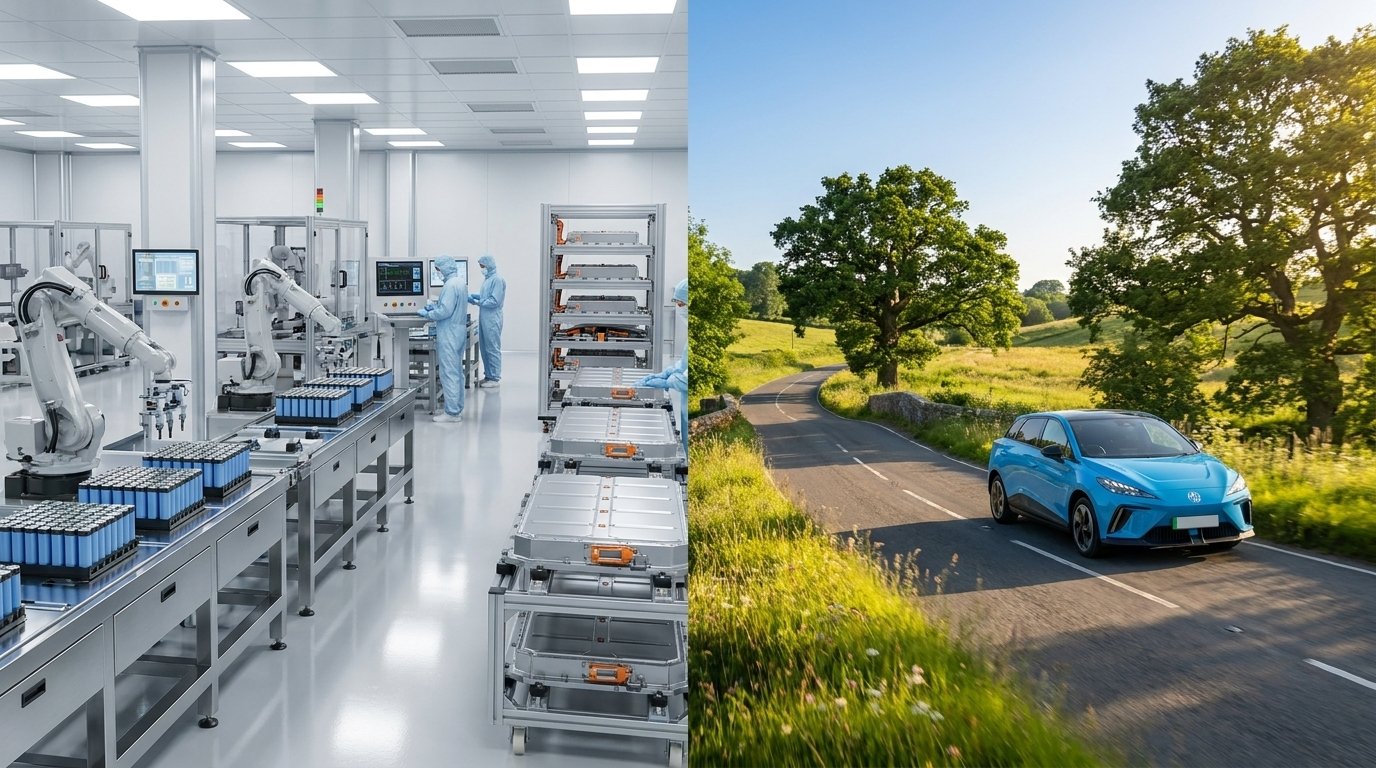
A colleague of mine bought a Hyundai Ioniq 6 last year. Within a week, someone in his office told him it was “worse for the environment than a petrol car because of the batteries.” He came to me genuinely unsettled, wondering if eco-friendly electric cars were just a marketing myth or if he had genuinely made a mistake.
I didn’t have a clean answer on the spot. So, I spent the better part of a month actually looking into it—reading lifecycle analyses, talking to owners, digging into National Grid data, and trying to get past both the EV marketing and the anti-EV contrarianism that fills comment sections.
What I found wasn’t the simple “yes, obviously green” story the adverts sell. It also wasn’t the “EVs are secretly dirty” story the sceptics love. The real picture is more specific than either camp usually admits—and a lot more useful once you actually understand it.
The Question Itself Needs to Be More Precise
Asking “are EVs good for the environment?” is a bit like asking “is a diet healthy?” The answer completely depends on what you are eating, how much, and what you are comparing it to.
For electric vehicles, the relevant questions are: compared to what? Over what timeframe? In what country? With what electricity source? Manufactured where? Every one of those variables changes the answer.
The people saying EVs are dirty are usually picking the worst-case combination of those variables. The people saying EVs are flawlessly clean are usually picking the best-case. The truth sits in the middle—and the middle is actually quite good for EVs in most realistic UK scenarios.
Eco-friendly Electric Cars: The Manufacturing Problem is Real
Making an EV battery is carbon-intensive. Lithium has to be mined from brine pools or hard rock deposits in Chile, Australia, and China. Cobalt comes primarily from the DRC, where mining conditions are a whole separate ethical problem. Nickel refining is energy-heavy. Before an EV drives a single mile, its battery has already generated somewhere between 6 and 16 tonnes of CO₂ equivalent, depending on the battery size and where it was manufactured.
That is real. It is not propaganda. And it means an EV starts its life with a carbon debt that a petrol car does not carry to the same degree.
How fast do eco-friendly electric cars pay back their carbon debt?
The External Link: International Council on Clean Transportation (ICCT) has done the most thorough lifecycle analyses available. Across Europe, the US, China, and India, they consistently find EVs producing 50–70% lower lifetime emissions than petrol cars—even when accounting for manufacturing. The breakeven point typically falls between 12,000 and 30,000 miles depending on the local grid mix and battery size.
For a UK driver covering 10,000 miles a year, that is roughly 1.5 to 3 years. After that, every mile driven is cleaner than the petrol alternative—by a widening margin as the grid gets greener.
The Grid is the Biggest Variable Most People Underestimate
An EV charged entirely on coal-generated electricity is not a completely clean vehicle. Its operational emissions are still lower than a combustion engine (which we explored in our recent EV vs petrol cars UK comparison), but the gap is much smaller.
Clean grid examples: France (~70% nuclear), Norway (~98% hydro), and the UK (near-zero coal, high wind). EVs here operate with some of the lowest lifecycle emissions possible.
Mixed grid examples: Poland or parts of India (coal-heavy). EVs still outperform petrol, but the gap narrows considerably.
The part that consistently gets missed: an EV bought today gets progressively cleaner over its 10-year life as national grids add more renewable capacity. A petrol car bought today will emit roughly the same carbon in 2035 as it does now. In the UK, you can use the official National Grid ESO Carbon Intensity app to check exactly how clean your electricity is at any given hour based on your postcode.
If you want to bypass the grid entirely, charging an EV with solar panels at your home drops your day-to-day emissions to practically absolute zero.
Mining and Supply Chains: The Hardest Part to Dismiss
Battery manufacturing isn’t just a carbon problem. It is a resource problem.
Lithium extraction uses enormous amounts of water. Cobalt mining in the DRC has well-documented child labour and safety problems. Is it getting better? Yes. Battery chemistry is shifting. LFP (lithium iron phosphate) batteries—used extensively by BYD and increasingly by Tesla—contain absolutely no cobalt and use more abundant materials. That is a real improvement, even if the industry still has a long way to go.
Air Quality: The Dimension That Often Gets Skipped
Carbon gets most of the attention, but there is another environmental dimension where EVs win clearly and immediately: local air quality.
Petrol and diesel combustion produces nitrogen oxides, particulate matter, and carbon monoxide at street level—near schools, hospitals, and in neighbourhoods where people actually breathe. EVs produce none of these at the tailpipe. If you live near a busy road in London or Birmingham, the people around you breathe differently depending on what percentage of that traffic is electric.
The Honest Bottom Line
Eco-friendly electric cars are genuinely cleaner than petrol cars in most situations—measurably, not marginally—when you look at the full lifecycle and do not selectively pick which phase of the car’s life to analyse.
The manufacturing problem is real but finite. The operational advantage compounds over years. The grid gets cleaner whether you do anything about it or not. The supply chain issues around lithium and cobalt are genuine and deserve accountability, but they do not flip the environmental equation. On balance, the EV industry produces vehicles with a substantially better lifetime carbon profile than the combustion engines they replace.
FAQs: The Environmental Impact of EVs
1. Are eco-friendly electric cars actually better for the UK environment?
Yes. Because the UK National Grid relies heavily on wind, solar, and nuclear power, the electricity used to charge an EV is very clean. Even when accounting for the carbon-intensive battery manufacturing process, an EV driven in the UK will produce 50–70% fewer emissions over its lifetime compared to a petrol equivalent.
2. Do EV batteries just end up in landfills?
This is a common myth. In 2026, EV batteries rarely go to landfills. Major manufacturers and specialised recycling companies like Redwood Materials recover lithium, cobalt, and nickel at a commercial scale. Furthermore, UK and European regulations mandate strict battery recycling targets.
3. How long does it take for an electric car to offset its manufacturing emissions?
For the average UK driver covering around 10,000 miles annually, it takes between 1.5 and 3 years of driving to break even on the carbon debt created during battery manufacturing. Every mile driven after this point is a net positive for the environment.
4. Which EV battery type is the most ethical to buy?
If supply chain ethics are a major concern for you, look for vehicles that utilise LFP (Lithium Iron Phosphate) batteries. Manufacturers like BYD and certain Tesla trims use LFP chemistry, which completely eliminates the need for cobalt—a mineral historically associated with problematic mining practices.