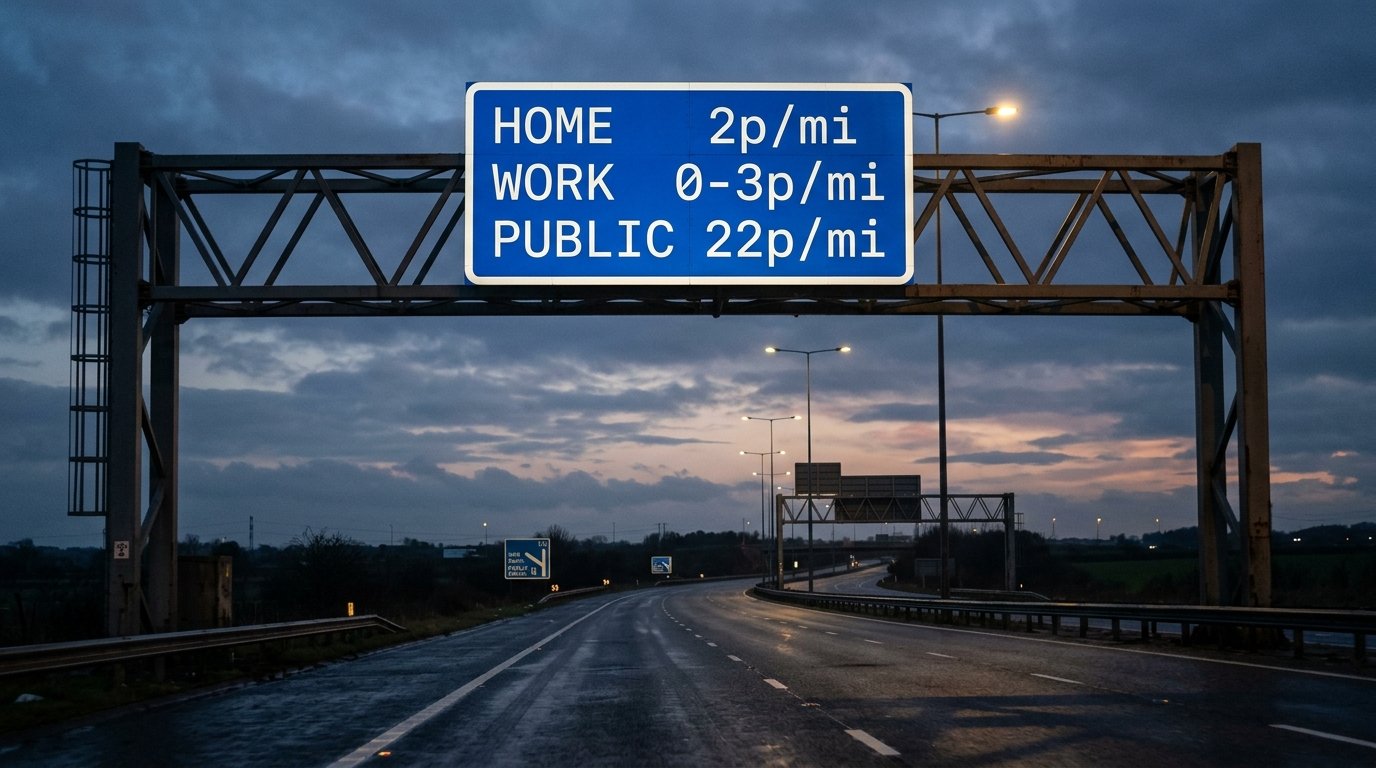
Everyone tells you EVs are cheaper to run. Nobody tells you that the gap between the cheapest and most expensive way to charge the exact same car is nearly 6x.The cheapest way to charge an EV in the UK is off-peak home charging on a smart tariff. Here’s exactly how much you’ll pay across home, public, and workplace charging in 2026, with real numbers per mile.
The Short Answer: Weekly Cost Comparison
Running cost for the same 300-mile week, on a typical EV doing 3.5 miles per kWh:
| Charging method | Rate | Weekly cost (300 miles) |
|---|---|---|
| Home, off-peak tariff | 7p/kWh | ~£6 |
| Home, standard rate | 25p/kWh | ~£21 |
| Workplace | Free–subsidised | £0–£10 |
| Public rapid/ultra-rapid | 75–85p/kWh | ~£65–£73 |
Same car. Same miles. The difference between charging smart at home and relying on public rapids is over £3,000 a year. That’s the whole ballgame.
Home Charging: The Cheapest Way to Charge an EV in the UK
If you have a driveway and a home charger, this is your default, and it’s not close.
The saving doesn’t come from the charger itself, it comes from the off-peak EV tariff. Providers like Octopus Intelligent Go, OVO Charge Anytime, and E.ON Next Drive offer overnight rates around 7p–10p per kWh, against the ~25p standard rate. You plug in when you get home, the car charges automatically in the cheap window overnight, and you wake up full.
Real Cost Per Mile at Home
At 7p/kWh and 3.5 mi/kWh, you’re paying 2p per mile. A petrol car doing 45mpg at £1.40/litre costs about 14p per mile. That’s a 7x saving on fuel alone.
The catch: you need off-street parking and a home charger installed (budget £800–£1,200 — see our full EV Home Charger Installation Cost UK guide). That cost typically pays back within the first year of tariff savings.
Workplace Charging: A Cheap Way to Charge an EV Without a Driveway
If your employer has chargers, use them. A lot of UK workplace charging is free or heavily subsidised as a staff perk, and even when it’s paid, it’s usually cheaper than public rapids.
For people without a driveway, workplace charging is often the single best option available, sometimes even beating home standard-rate charging. Worth asking HR whether your office is planning to install points, many are, thanks to grant schemes.
Public Charging in the UK: The Most Expensive Way to Charge an EV
This is where the “EVs are expensive” myth comes from. If you rely on public rapid and ultra-rapid chargers, you’re paying the most, by a wide margin.
According to the Zapmap Price Index, the weighted average UK public charging price in May 2026 was 54p/kWh on Standard and Standard Plus chargers (up to 49kW), and 79p/kWh on Rapid and Ultra-rapid chargers (50kW+).
| Charger type | Speed | Typical price | Cost per mile |
|---|---|---|---|
| Standard / Standard Plus | up to 49kW | ~54p/kWh | ~16p |
| Rapid / Ultra-rapid | 50kW+ | ~79p/kWh | ~24p |
At the rapid/ultra-rapid rate, that same EV costs about 24p per mile, more than a petrol car. Public charging makes sense for topping up on long trips, not as your daily charging strategy. For a full breakdown, see our Best UK Rapid Charging Networks Compared.
Subscription Plans Can Lower Public Charging Costs
Subscription plans (BP Pulse, Tesla membership) knock 10–20p/kWh off if you’re a frequent public charger. Only worth it if you genuinely can’t charge at home or work.
Cost Per Mile: Comparing Every Way to Charge an EV in the UK
| Method | Cost per mile |
|---|---|
| Home, off-peak (7p/kWh) | ~2p |
| Home, standard rate (25p/kWh) | ~7p |
| Petrol, 45mpg | ~14p |
| Public Standard/Standard Plus (54p/kWh) | ~16p |
| Public Rapid/Ultra-rapid (79p/kWh) | ~24p |
The takeaway is blunt: charge at home off-peak and an EV is dramatically cheaper than petrol. Rely on public rapids and it can cost more than petrol.
What Should You Actually Do?
- Have a driveway? Get a home charger and an off-peak tariff. Biggest saving available, and it’s not close.
- No driveway, but workplace charging? Lean on that, and use public slow chargers to top up when needed.
- No driveway, no workplace charging? An EV still works, but budget more, prioritise a subscription plan, and look for cheaper destination charging at supermarkets or gyms.
The Bottom Line
The cheapest way to charge an EV in the UK in 2026 is off-peak home charging at ~7p/kWh, working out to roughly 2p per mile. Workplace charging is a close second where available. Public rapid charging is the expensive option that gives EVs a bad reputation on cost, so save it for road trips rather than daily use.
Frequently Asked Questions
What is the cheapest way to charge an electric car in the UK?
Off-peak home charging on a smart EV tariff is the cheapest, at around 7p per kWh (roughly 2p per mile). You plug in overnight and the car charges automatically during the cheap window.
How much does it cost to fully charge an EV at home in the UK?
A typical 60kWh EV costs about £4–£5 to fully charge on an off-peak tariff (7p/kWh), or around £15 on the standard rate (25p/kWh).
Is public charging more expensive than petrol?
It can be. At ultra-rapid rates of 75–85p/kWh, an EV costs about 21–24p per mile, more than a 45mpg petrol car (~14p per mile). Public rapid charging is best saved for long trips, not daily use.
Do I need a home charger to save money?
It helps significantly, but it’s not the only route. Workplace charging, often free or subsidised, can also keep costs low without a driveway. Relying purely on public rapids is where costs climb.
Which UK tariffs offer the cheapest EV charging?
Smart EV tariffs like Octopus Intelligent Go, OVO Charge Anytime, and E.ON Next Drive offer overnight rates around 7p–10p per kWh, well below the ~25p standard rate.
Is workplace charging really free?
Often, yes. Many UK employers offer free or subsidised charging as a staff perk. Even when paid, it’s usually cheaper than public rapid charging.