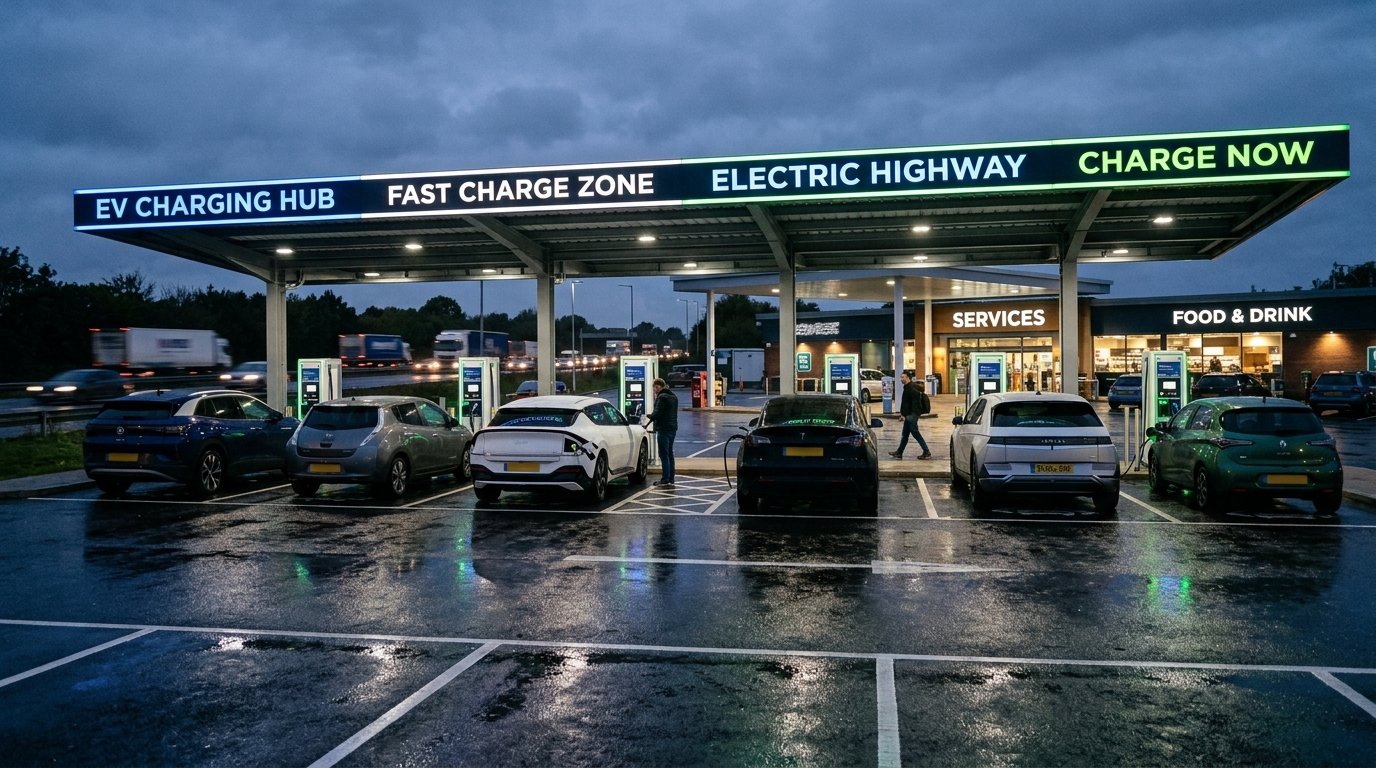
As of July 2026, Tesla’s open Supercharger network is the cheapest widely available rapid charging option in the UK at roughly 55–65p per kWh, while InstaVolt and BP Pulse sit at the top of the price table around 89–92p per kWh on pay-as-you-go. Gridserve and Ionity land in between, with subscriptions on every network cutting 15–30% off the headline rate. If you’re choosing which app to download before a long trip, that’s the short version of how UK rapid charging networks stack up. The longer version — where each network actually wins — is below.
Why This Matters Right Now
The UK’s public charging network has grown fast enough that the old advice — “just use whatever’s nearest” — no longer holds. There were 119,080 public EV chargers in the UK as of April 2026, and rapid or ultra-rapid units on UK rapid charging networks (50kW and above) now number over 28,000. Ultra-rapid provision specifically has grown 39–40% year on year, concentrated in motorway hubs run by a handful of competing operators. That growth is good news for range anxiety. It’s less good news for your wallet, because the gap between the cheapest and most expensive rapid network on a single 60kWh top-up is now around £18 — for identical electricity. I’ve charged on every major UK network at some point over the past year, mostly on the M6 and M40 corridors and a few Highland trips where the nearest charger genuinely was the only option. The differences aren’t subtle once you’re paying attention.
How UK Rapid Charging Networks Actually Compare
Prices move often — some networks have adjusted twice in the past six months — so treat this as a July 2026 snapshot rather than gospel. Always check the app before you plug in.
| Network | PAYG Price (per kWh) | Max Speed | Subscription Option | Reliability |
|---|---|---|---|---|
| Tesla Supercharger (open network) | ~55–65p (contactless), from ~41p off-peak | Up to 250kW | £8.99/month membership drops rate further | Industry-leading, 99%+ claimed uptime |
| Ionity | 76–93p, ~69p for subscribers | Up to 350–400kW | Ionity Power £10.50/month (~46p/kWh) | Good, expanding urban hubs in 2026 |
| Gridserve | 82–89p | Up to 350–360kW | Gridserve Plus £7.99/month (25% off) | Strong; Electric Forecourts add seating and food |
| BP Pulse | up to 89p | Up to 150kW | £7.85/month, first month free | Moderate — some out-of-service reports |
| InstaVolt | Up to 92p peak, 55–60p off-peak (app) | Up to 125–180kW | No subscription; app unlocks off-peak rate | Good, ~95% uptime, contactless everywhere |
| Osprey | 82–87p (74p weekends via app) | Up to 150–300kW | None required | Strong, good rural coverage |
A few things jump out from that table. First, Tesla’s open network isn’t just cheap — it’s cheap and fast, which is unusual. Most networks force a trade-off between the two. Second, subscriptions on Gridserve, Ionity and BP Pulse pay for themselves within one or two charging sessions if you’re doing more than a handful of rapid charges a month, so the PAYG price is often the wrong number to compare on if you charge in public regularly.
UK Case Study: A Scottish Highlands Trip
Take a typical run from Glasgow to Fort William and back, roughly 200 miles round trip with one charging stop each way. On the outbound leg, the nearest rapid option is an Ionity hub — PAYG that’s around 85p/kWh, but with the Ionity Power subscription it drops to about 46p. For a 40kWh top-up, that’s the difference between roughly £34 and £18. On a route with limited charger density, you often don’t get to shop around between operators the way you can on the M1 corridor, so knowing the subscription math before you leave home matters more in the Highlands than it does commuting into London.
Speed vs Price: The Real Trade-Off
Ultra-rapid chargers (150kW+) sound like the obvious choice, but Zap-Map’s utilisation data shows the average real-world charge rate on ultra-rapid units is around 55kW — about 26% of the stated maximum. Battery chemistry, ambient temperature and how full your battery already is all throttle the actual speed you get, regardless of what the charger is rated for. Paying a premium for a 350kW charger doesn’t guarantee a 350kW session, especially past 50% state of charge.
For most UK drivers, a 100–150kW rapid charger delivering close to its rated speed is often better value than chasing the highest number on the sign — one more reason raw kW figures alone are a poor way to judge UK rapid charging networks.
The Catch: Where the Networks Fall Short
None of the UK rapid charging networks covered here are flawless, and the marketing rarely mentions the gaps:
- Reliability varies by site, not just by brand. A BP Pulse charger at one services can be spotless while another 40 miles away has been broken for weeks. Check recent Google reviews for the specific location, not just the network’s overall reputation.
- Contactless isn’t universal on older units. Chargers installed before November 2024 aren’t legally required to have contactless payment, so some older 50kW rapids still need an app or RFID card.
- Winter range drop hits charging math too. Cold batteries charge more slowly and less efficiently, so a session that takes 35 minutes in July can take 50+ in January — budget extra time, not just extra cost.
- Subscription overlap is common and wasteful. Paying for three network memberships when you only regularly use one or two motorway routes is a false economy. Match the subscription to your actual driving pattern.
Roaming Cards and Fleet Cards: Skip the App Juggling
If you’re regularly crossing between three or four networks — say Gridserve on the motorway, Osprey at supermarkets and BP Pulse near home — managing separate apps and top-up balances gets old fast. Roaming cards like Paua and Plugsurfing work across most major networks on a single account, which won’t necessarily get you the cheapest in-app rate at any one operator, but it removes the friction of downloading a new app every time you’re somewhere unfamiliar. For company car drivers on salary sacrifice schemes, a February 2026 tax tribunal ruling also confirmed public EV charging qualifies for the reduced 5% VAT rate rather than the standard 20%, which has pushed several employers toward dedicated charging cards that apply the saving automatically rather than requiring drivers to claim it back.
UK Case Study: The London Commuter Without a Driveway
Roughly a third of UK households don’t have off-street parking, which means no home charger and a heavier reliance on public infrastructure for day-to-day top-ups, not just long trips. For a London-based driver without a driveway, the calculation looks different from the Highlands scenario above: destination chargers at supermarkets and Standard Plus on-street units (8–49kW) are usually the better value than rapid charging for routine top-ups, since rapid pricing is built around speed for through-traffic, not overnight convenience. Zap-Map’s own data puts Standard/Standard Plus charging at an average of around 54p per kWh — cheaper than any rapid network on this list — precisely because you’re not paying a premium for the fast turnaround. Saving rapid and ultra-rapid charging for genuine en-route top-ups, and using slower on-street or destination charging for the rest, is the single biggest cost lever available to anyone charging exclusively in public.
Frequently Asked Questions
Q: Which UK rapid charging network is cheapest overall?
A: Tesla’s open Supercharger network, at roughly 55–65p per kWh PAYG and lower with membership, is consistently the cheapest widely available option, even for non-Tesla drivers using the Tesla app.
Q: Do I need a different app for every charging network?
A: Not necessarily. Contactless payment is mandatory on new chargers above 8kW and on all rapid chargers 50kW and above, so you can pay by card almost everywhere. Apps are only essential if you want the discounted in-app rate.
Q: Is Ionity or Gridserve better for a long motorway trip?
A: Gridserve has wider motorway services coverage and better amenities at its Electric Forecourts; Ionity generally offers higher peak charging speeds where both are available. Route-dependent — check coverage on Zap-Map before committing to one subscription.
Q: Are ultra-rapid chargers worth the extra cost over rapid?
A: Only if your car can actually accept the higher power and your battery is below roughly 50% charge. Above that, charging curves taper regardless of the charger’s rating, so you’re often paying an ultra-rapid premium for a rapid-speed session.
Q: How much does home charging save compared with public rapid charging?
A: Roughly ten times less. Off-peak smart tariffs run around 7–8p per kWh, against a public rapid weighted average near 79p per kWh as of Zap-Map’s May 2026 price index.
Final Verdict
If you only remember one thing about UK rapid charging networks in 2026: default to Tesla’s open network when it’s on your route, and treat InstaVolt or BP Pulse PAYG as the emergency top-up, not the habit. For regular motorway drivers, pick the one or two subscriptions that match your actual routes rather than collecting all of them. And check the specific charger’s reviews, not just the network’s reputation — reliability in 2026 is still a site-by-site game, not a brand-wide guarantee.