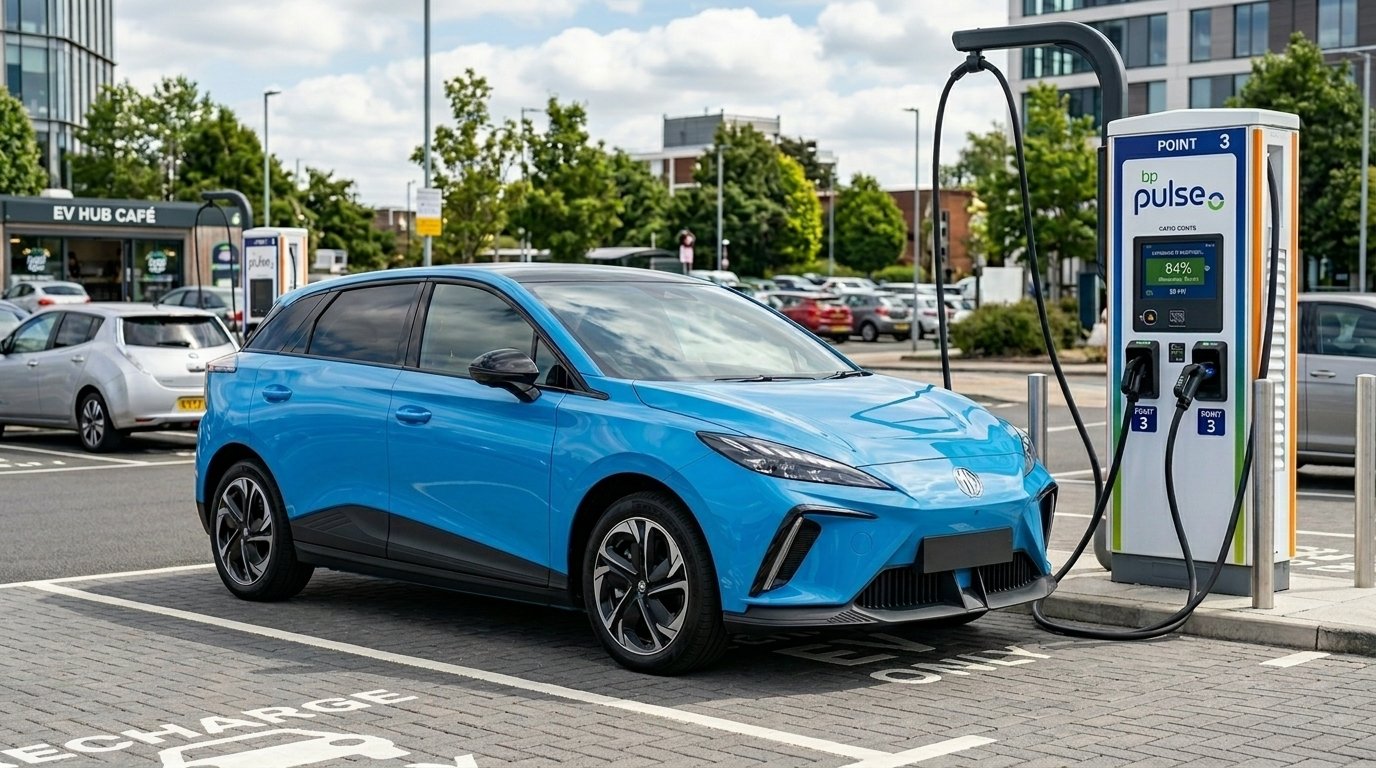
As of June 2026, MG has confirmed the MG SolidCore battery UK launch for late 2026, landing first in the MG4 Urban. It’s a genuine first. No other manufacturer runs semi-solid-state batteries in mass production for Europe yet — not Toyota, not Nissan, not anyone. But “first to market” and “actually worth waiting for” are two different questions. Right now, marketing language is doing work that hard numbers should be doing.
I keep recommending the MG4 Urban to people asking about a sub-£25k EV. So when MG announced SolidCore at their Frankfurt event in March, my first reaction wasn’t excitement. It was more: “Okay, but what does this actually change for someone buying one this autumn?” Here’s what’s solid, and what’s still a question mark.
What SolidCore Actually Is
Despite the name, this isn’t a solid-state battery. MG’s own Chief Battery Scientist, Dr Li Zheng, admitted that at the technical reveal. SolidCore cells still contain roughly 5% liquid electrolyte, compared to 10-15% in a conventional lithium-ion cell. That remaining liquid does a specific job. It maintains conductivity at the point where the electrolyte meets the cathode and anode — exactly where fully solid-state batteries have struggled for the past decade.
So this sits in the middle of a spectrum. Conventional lithium-ion sits at one end. Full solid-state sits at the other, and nobody has that in a production car yet — Toyota and Nissan both target 2028 at the earliest. SolidCore is MG’s bet: get most of the benefit without solving the hardest 5% of the problem.
The cell chemistry itself uses lithium-manganese-oxide (LMO), not the NMC or LFP most UK buyers expect to see on a spec sheet. MG says this gives the cell a three-dimensional spinel structure. That apparently handles rate capability and thermal stability better than LFP’s flatter structure. I’ll be honest — I can’t independently verify that claim without lab access, and neither can most outlets covering this. What I can verify is what MG promises in practical terms.
The Three Claims That Matter
MG lists three headline improvements over its current LFP packs: 15% faster charging in cold conditions, 20% better power delivery, and improved safety from the reduced liquid electrolyte content. Each deserves a closer look.
Cold-weather charging is the one I’d actually pay attention to. If you’ve owned an EV through a UK winter, you already know the problem. Conventional lithium-ion batteries slow down dramatically below freezing because the liquid electrolyte thickens. Every EV owner I know in Scotland or the North has a story about a January charging session that took twice as long as expected. Cutting the liquid content to 5% should genuinely help here — there’s simply less viscous fluid to fight against. This is the claim with the clearest physical mechanism behind it.
Power delivery is the claim I trust least from outside. A 20% improvement sounds impressive, but MG hasn’t said what baseline they’re comparing against, or under what conditions. Until an independent reviewer gets a SolidCore test car on actual UK roads, this stays a manufacturer number rather than a fact.
Safety is likely real but hardest to prove without an incident actually happening — and to be clear, that’s not something I’m hoping for. Less flammable liquid content is a straightforward engineering improvement: fewer thermal runaway risk factors. MG frames this as reduced dependence on inter-cell barriers and active cooling redundancy. If true, that could eventually mean lighter, cheaper battery packs down the line — a longer-term implication rather than something Urban buyers see this year.
The China Data Point Worth Knowing
MG didn’t launch SolidCore from nothing — it’s already shipping in China. An MG4 EV Urban with a 53.95kWh SolidCore pack went on sale there in December. It carries a CLTC-rated range of 530km (roughly 329 miles) and 2C fast charging that takes the battery from 30% to 80% in 21 minutes.
Two things stand out from that. First, CLTC figures run more generous than WLTP. UK buyers shouldn’t expect anything close to 329 miles from the same pack once it’s rated under the European test cycle. Second, the China-spec battery capacity (53.95kWh) is almost identical to the current LFP pack in the UK’s MG4 Urban Long Range (53.9kWh). That’s a strong signal the UK version won’t dramatically increase range — the improvement is likely concentrated in charging behaviour and cold-weather performance rather than headline mileage. You can work out what the running cost difference might look like using our UK EV charging cost calculator.
What’s Confirmed for the UK, and What Isn’t
Confirmed: SolidCore arrives in Europe by the end of 2026, with the MG4 Urban as the launch vehicle. MG has stated the UK gets it ahead of other European markets. The current MG4 Urban LFP range will continue selling alongside the SolidCore version rather than being replaced outright.
Not yet confirmed: pricing for the SolidCore variant, UK-specific WLTP range and charging figures, whether SolidCore eventually replaces the standard LFP pack or stays a premium option, and the exact UK on-sale date beyond “before the end of 2026.”
For context on what you’d be comparing it against, the current MG4 Urban range looks like this:
| Variant | Battery | WLTP Range | DC Charging | UK Price |
|---|---|---|---|---|
| Comfort Standard Range | 42.8kWh LFP | Up to 201 miles | 87kW, 20-25 min (10-80%) | £23,495 |
| Comfort Long Range | 53.9kWh LFP | Up to 258 miles | 87kW, 30-35 min (10-80%) | £25,495 |
| Premium Long Range | 53.9kWh LFP | Up to 258 miles | 87kW, 30-35 min (10-80%) | £27,995 |
MG also currently offers a £1,500 price match against the government’s EV grant, which brings the entry Comfort Standard Range down to roughly £21,995. Whether that same discount applies to a SolidCore variant is unconfirmed. Check MG’s UK website directly for the latest official pricing.
How Does This Compare to Other EVs on Range?
If range matters more to you than charging speed, run the numbers on real-world range for whichever car you’re considering. WLTP figures across all manufacturers are measured in lab conditions at 23°C, which doesn’t reflect a UK winter commute. The MG4’s LFP battery already handles cold weather better than some NMC competitors. The SolidCore improvement builds on that baseline rather than fixing a serious weakness. The case for SolidCore rests on cold-weather charging, not range.
For a broader picture of how the MG4 sits against alternatives, our EV vs petrol running cost comparison covers the full-year financial case — useful if you’re still deciding whether to switch at all.
What This Means for Buyers
If you need a car this summer, buy the current MG4 Urban on its merits. It’s already one of the strongest value propositions under £25k in the UK, LFP battery and all. Don’t hold out for SolidCore based on marketing claims that haven’t been independently tested.
If you can genuinely wait until late 2026, and winter charging speed is a real pain point — long motorway commutes, no home charger, regular reliance on public rapid chargers in cold weather — SolidCore is worth watching. Go in expecting a charging-speed and cold-weather improvement, not a range revolution. The China battery capacity figures suggest this isn’t a bigger pack, it’s a smarter one.
I’ll update this piece once MG confirms UK pricing and WLTP figures, and again once independent UK reviewers get real-world testing time with a SolidCore car.
FAQ
Q: Is the MG SolidCore battery fully solid-state? A: No. It’s semi-solid-state, meaning roughly 5% liquid electrolyte remains in each cell, compared to 10-15% in MG’s conventional lithium-ion batteries. Full solid-state batteries — with no liquid electrolyte at all — aren’t expected in any production car before 2028 at the earliest.
Q: When can I buy an MG4 Urban with a SolidCore battery in the UK? A: MG has confirmed European availability by the end of 2026, with the UK as the first market. An exact on-sale date and order books haven’t been announced yet.
Q: Will the SolidCore battery cost more than the current MG4 Urban? A: Pricing hasn’t been confirmed. Based on MG’s recent pricing strategy, the SolidCore version is likely to be positioned competitively against rivals like the Tesla Model 3 and Hyundai Ioniq 6 rather than carrying a steep premium, but this is not yet officially confirmed.
Q: Does SolidCore mean longer range than the current MG4 Urban? A: Probably not significantly. The China-market SolidCore battery (53.95kWh) is almost the same capacity as the UK’s current 53.9kWh LFP pack. The main improvements are expected in charging speed, cold-weather performance, and power delivery rather than outright range.
Q: Is a semi-solid-state battery safer than a normal EV battery? A: MG says yes, because reducing liquid electrolyte content lowers the risk of thermal runaway. This is a plausible engineering claim, but it hasn’t been independently verified through crash or abuse testing on UK-spec cars yet.