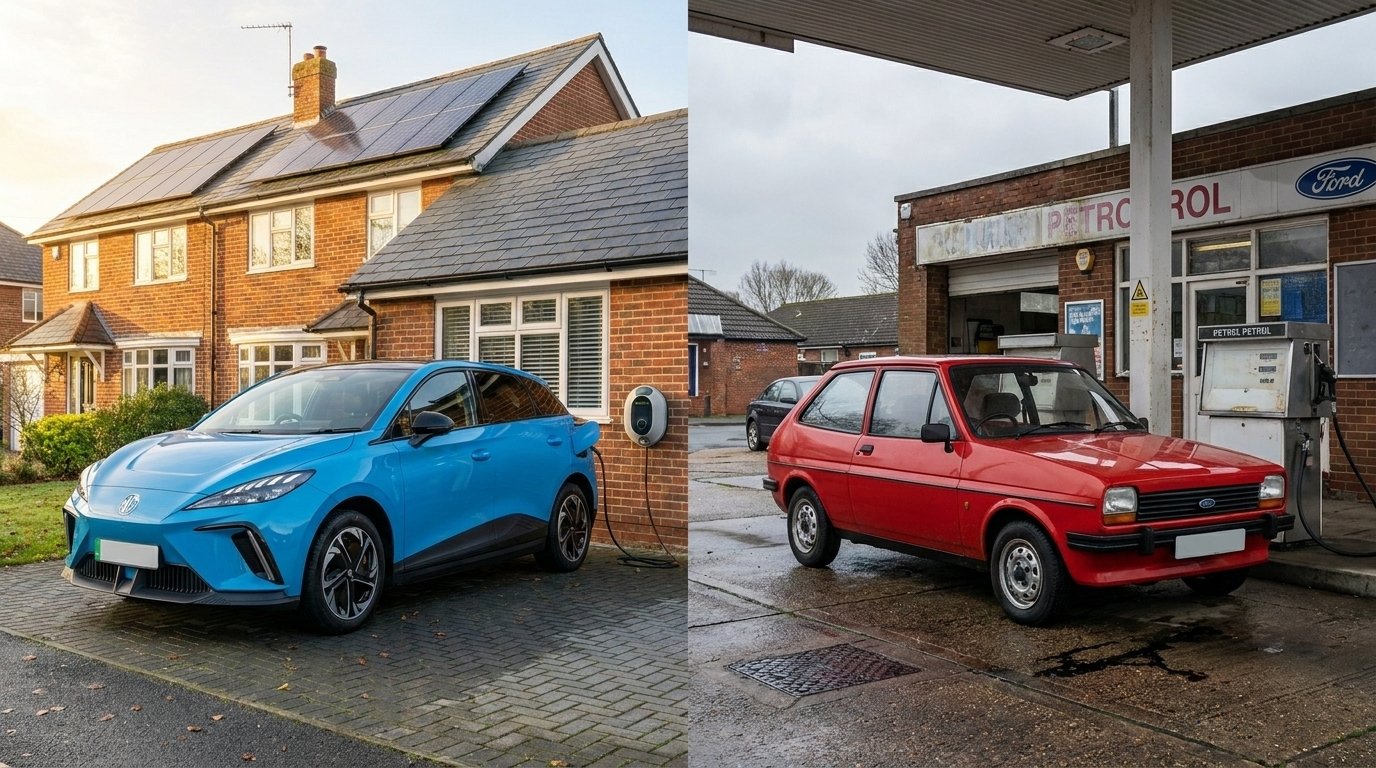
When weighing up EV vs petrol cars UK drivers are often caught between exaggerated marketing and outdated myths. My cousin called me last March in full panic mode. He had just put a deposit on a petrol Volkswagen Golf—automatic—and then his colleague showed up to the office in a BYD Seal and started talking about home charging costs. “Did I just make a mistake?” he asked.
Honestly? I didn’t know what to tell him right away. Because the answer isn’t as clean as EV Twitter wants you to believe, and it is not as simple as petrol loyalists make it sound either. I have spent the better part of two years going back and forth on this—test driving, talking to owners, and crunching the fuel numbers. Let me share what I have actually figured out.
The Cost Question (It’s Not What You Think)
Everyone starts with the purchase price, which is fair. EVs are still more expensive upfront in the UK market. A decent entry-level EV—think the MG4 EV, BYD Atto 3, or Hyundai Ioniq 5—sits somewhere in the £25,000–£45,000 range depending on the trim. A comparable petrol car can be £5,000–£10,000 less.
loveelectric
But here is where people mess up the maths: they stop right there.
In 2026, comparing EV vs petrol cars UK running costs comes down entirely to where you charge. I tracked a friend’s Hyundai Ioniq 6 for three months; on an off-peak EV tariff like Intelligent Octopus Go, he was paying roughly £2.50 per 100 miles in electricity. His old petrol Ford Focus was costing around £16.00 for the exact same distance. That gap compounds fast.
Woodson Cars
Maintenance reality check: No oil changes, no transmission fluid, and fewer brake pad replacements (regenerative braking does most of the work). However, it is worth noting that EV insurance in the UK currently averages about 15% higher than petrol equivalents, and as of recent changes, EVs now pay the standard £200 annual Vehicle Excise Duty (road tax). Even with these, if you keep your car for 5+ years, EVs almost always win on the total cost.
CUPRA+ 1
EV vs Petrol Cars UK: The Charging Reality
Charging anxiety is real—but it is also often overstated if you have somewhere to charge at home.
Home charging: a genuine game-changer If you live in a house with a driveway and can install a smart home EV charger, day-to-day EV life is incredibly convenient. You plug in at night and wake up to a full battery. You stop thinking about it the same way you stop thinking about charging your phone overnight.
Public charging: still catching up If you live in a flat with no charging access, or regularly drive 250+ miles in a single stretch, the calculus changes completely. Fast chargers exist along major motorways in 2026, but I have heard firsthand stories of people queuing 30–40 minutes at a Gridserve or InstaVolt charger during bank holiday weekends. Moreover, public rapid charging (often 60p–80p per kWh) can sometimes cost more per mile than petrol.
EV Break-Even Calculator UK
Range: Getting Past the Marketing Numbers
Manufacturers love quoting “up to 300 miles of range”—and that is technically true under laboratory conditions, on a mild spring day.
Real-world range is usually 15–25% less. Cold British winters hit EV batteries hard; owners in colder areas of Scotland often report a 25–30% range reduction in January. Running the cabin heater makes it worse.
Modern petrol cars do not have this problem. A 50-litre tank in a normal hatchback gets you roughly the same range in January as it does in July. That predictability is valuable, especially for people who frequently drive to visit family across the country.
The Environment Bit
EVs are cleaner over their lifetime—but “in most places” does real work in that sentence. The battery manufacturing process has a high carbon cost upfront due to raw material mining.
loveelectric
However, here is the part that gets overlooked: an EV bought today gets progressively cleaner over its lifetime as the National Grid adds more wind and solar energy. A petrol car bought today will emit the exact same carbon in 2035 as it does now. That long tail matters.
Which Type of Driver Are You, Really?
When researching EV vs petrol cars UK buyers often ignore their actual daily routines. Forget the online debates; this is what actually determines the right answer.
An EV probably suits you if:
- You drive mostly within your city, county, or region.
- You have a driveway and can charge at home overnight on an off-peak tariff.
- Most of your journeys are under 200 miles in a single stretch.
- You plan to keep the car for 5+ years to recoup the upfront cost via fuel savings.
- You enjoy modern tech, app integrations, and a quiet ride.
A petrol car probably makes more sense if:
- You drive long distances regularly and cannot always plan charging stops.
- You only have street parking and no reliable access to home charging.
- Your budget is tight and financing a higher EV list price is a stretch.
- You regularly drive in extreme cold and cannot afford the winter range hit.
Mistakes People Make When Choosing
- Buying based on range alone: People buy a 350-mile-range EV when their daily commute is 15 miles. You are paying thousands of pounds for heavy battery capacity you will almost never use.
- Ignoring the home charging situation: I have seen people buy EVs and then discover their apartment building will not permit a charger installation, or the quote to run a cable is £3,000. Sort this out before you sign anything.
- Forgetting about resale values: EV depreciation has been volatile over the last few years. While some models hold their value beautifully, others drop faster than expected. Check the used market prices before committing. Zego Insurance
The Part I Didn’t Expect
I thought I would feel range anxiety when I borrowed a friend’s MG ZS EV for a week. I didn’t—because I never needed more than 60 miles in a single day and charged it every evening. What I did feel was oddly annoyed at petrol station stops whenever I drove other cars afterwards. Waiting in a queue. Touching a greasy pump handle. The lingering smell of diesel.
Most EV owners say they cannot imagine going back to stopping at petrol stations regularly. That daily user experience counts for something.
The Honest Takeaway
Do not let the EV evangelists or petrol holdouts push you into a binary. The better car depends entirely on how you actually live. If your charging access is sorted and your driving patterns fit—get the EV. The running costs are dramatically lower, the drive is smoother, and the tech is mature.
If home charging is a genuine obstacle or you do irregular long-distance driving, get a good petrol car, or look seriously at a hybrid. A Toyota Yaris Cross or Honda HR-V hybrid gives you brilliant fuel efficiency without the plug-in dependency. It is an underrated middle ground that doesn’t get enough attention in this debate.