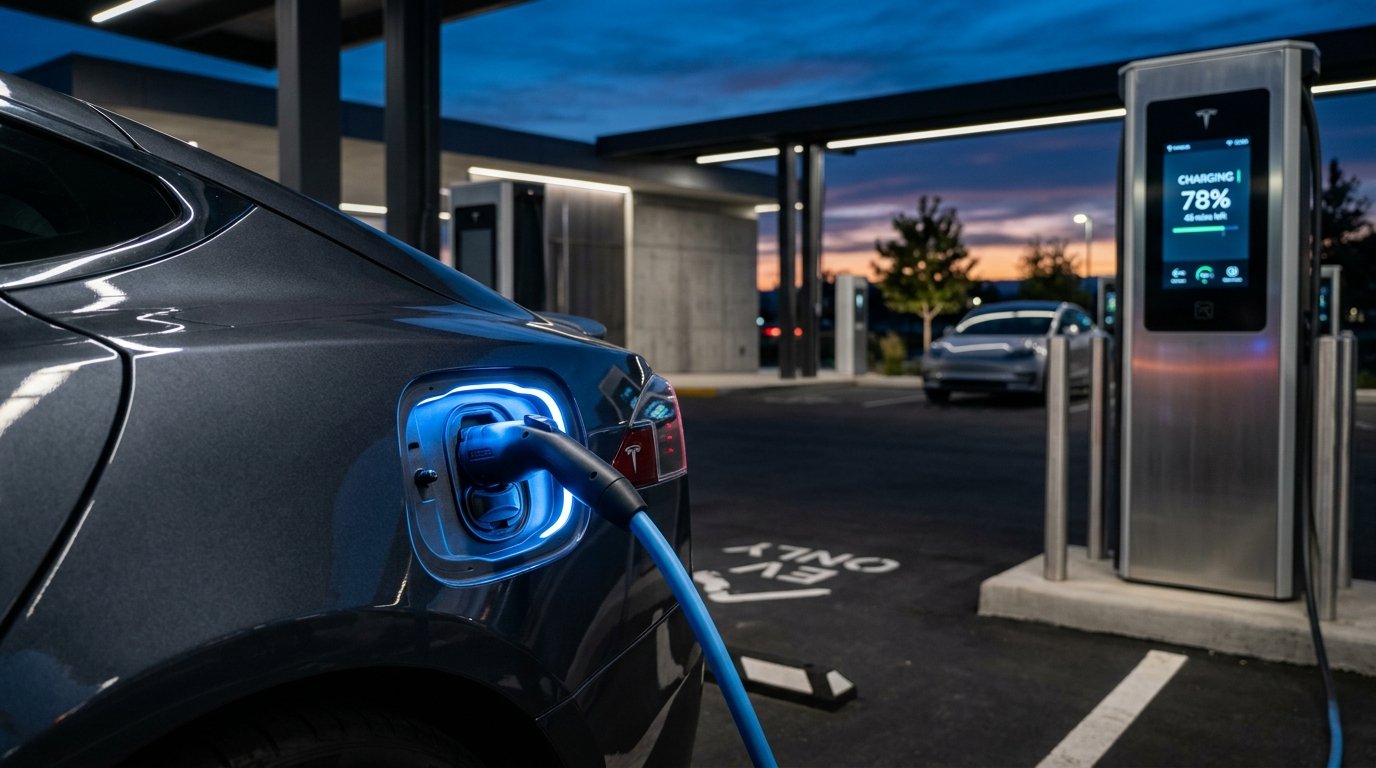
Walk into any EV showroom in the UK and you’ll hear plenty of promises. But behind the marketing, there’s one question every buyer should actually ask: how long before that battery starts losing its punch? As of June 2026, the honest answer is reassuring — and the data backs it up properly now, not just manufacturer claims.
If you’re weighing up EV battery cost in the UK against how long a pack actually lasts, this is the article that puts both sides together.
The 200,000-Mile Test
Some of the highest-mileage Teslas on UK and European roads have travelled well over 300,000 miles (480,000 km) on their original battery packs. These aren’t carefully cosseted showpieces — they’re ordinary minicabs and private hire vehicles driven in all weather, year-round.
The average UK driver covers around 7,400 miles a year, considerably less than the US average. At that pace, most EVs will comfortably exceed 200,000 miles before the battery shows meaningful wear — which, for most owners, is well beyond the point they’d have traded the car in anyway.
That’s longer than most people keep a car. It’s longer than most petrol engines last without major work. And it’s fundamentally changed how UK buyers should think about EV ownership.
What the Warranties Actually Mean
Every EV sold in the UK comes with a battery warranty, and reading the fine print reveals something worth understanding: manufacturers aren’t worried about sudden battery death. They’re guaranteeing capacity retention — meaning they’ll only repair or replace your battery if it drops below a certain threshold, usually 70% of its original rating.
Manufacturer coverage at a glance (UK)
| Manufacturer | Years | Miles | Capacity floor |
|---|---|---|---|
| Tesla | 8 years | 100,000–150,000 | 70% |
| Hyundai / Kia | 7–8 years | 100,000 | 70% |
| Volkswagen | 8 years | 100,000 | 70% |
| Nissan | 8 years | 100,000 | 70% |
| Renault | 8 years | 100,000 | 70% |
The consistency across manufacturers isn’t coincidence — it reflects engineering confidence backed by real fleet data. An automaker guaranteeing 70% capacity isn’t being generous out of charity. They’ve run the numbers, and they know the vast majority of batteries will sit comfortably above that line for years past the warranty’s end. Kia UK’s own published warranty terms are a good example of how these guarantees are actually worded.
How Batteries Actually Degrade
One of the most robust data sets on this comes from Geotab’s UK and European fleet study — over 22,700 vehicles tracked across real-world conditions. The headline finding: average degradation runs at roughly 2.3% per year, with 81.6% capacity typically retained after 8 years.
Real-world capacity at key milestones
| Mileage | Typical capacity remaining | What that means day-to-day |
|---|---|---|
| 50,000 miles | 92–96% | No noticeable difference from day one |
| 100,000 miles | 84–92% | A 300-mile WLTP car still does roughly 260 miles |
| 200,000 miles | 75–85% | Still 225+ miles — entirely practical for daily UK driving |
These are real fleet figures, not laboratory projections. Yes, range declines gradually. But 225 miles still covers the vast majority of daily UK journeys without much thought.
Why Your Charging Habits Matter
Battery chemistry responds to how you treat it, and the data on which habits cause the most wear is fairly consistent across manufacturers.
The single biggest factor: charging power, not the percentage you charge to. Geotab’s data actually pushes back on some of the old conventional wisdom here — for typical daily use, strictly sticking to a 20–80% routine made little measurable difference. Degradation only accelerated noticeably when a battery sat at very high or very low charge for more than 80% of its total time, parked and idle. The bigger factor by far is charging power itself: vehicles relying heavily on high-power DC fast charging above 100kW degraded at roughly double the rate of those mostly using AC or lower-power charging. So the practical takeaway isn’t “never charge to 100%” — it’s “don’t leave it sitting at 100% for days on end, and don’t make rapid charging your everyday habit if you can avoid it.”
Fast charging: useful, not free. DC rapid chargers are genuinely excellent for long-distance travel on UK motorways — going from 20% to 80% in 20–30 minutes at an Ionity or Gridserve site is a real breakthrough. But leaning on them as your daily charging method generates more heat over time, and heat is the enemy of battery longevity. Charging at home overnight on a 7kW home charger is the gentler approach if you’ve got the option.
Temperature: less alarming than you’d think, but not nothing. Cold UK winters reduce range noticeably — typically around a 28% drop in cold motorway conditions compared with mixed summer driving — but this doesn’t permanently damage the cells, it’s just chemistry slowing down temporarily. Extreme heat is actually the bigger long-term concern, though it’s a smaller factor in the UK climate than it would be somewhere hotter. Models with a standard-fit heat pump, like the Hyundai Ioniq 5 or Kia EV9, cope noticeably better in winter than those without one.
Quick charging rules for UK drivers
- Don’t leave the car sitting at 100% (or near-empty) for days at a time — that’s the real stressor, not the occasional full charge itself
- Use rapid/DC chargers for travel, not as your default daily method, since charging power matters more than charging percentage
- Precondition the battery while still plugged in before a cold-weather journey — it recovers a meaningful chunk of winter range loss
- If you can charge at home overnight on AC, it’s gentler on the pack long-term than relying on rapid chargers day to day
Replacement Cost: What It Actually Runs To
Eventually, some batteries do need replacing outside the warranty period. When that happens, what’s the real damage to your wallet?
EV battery cost in the UK for a full pack replacement typically runs between £5,000 and £15,000 depending on the vehicle and pack size, with premium models occasionally running higher. It’s worth being sceptical of headline “£20,000+” figures you’ll see thrown around — several detailed 2026 analyses suggest a more typical mid-size pack replacement is closer to £5,000–£6,000 in many real-world cases, not an automatic worst-case number. The full picture genuinely depends on the specific car and supplier, which is exactly why we’ve covered it in more depth in our dedicated EV battery cost UK guide.
That’s not trivial money. But weigh it against the alternative — a replacement engine in a premium petrol car can easily exceed £10,000, and a transmission rebuild commonly runs £3,000–£6,000. EVs eliminate a long list of traditional maintenance costs entirely: no oil changes, no exhaust system, no clutch, no timing belt.
Battery prices have also fallen roughly 80% over the past decade, and the trend hasn’t reversed. A replacement that costs £12,000 today is plausibly under £8,000 within five years, going by the manufacturing-scale trend tracked by BloombergNEF.
The Honest Verdict
If you’re waiting for EV batteries to become a genuine problem, you might be waiting a long time.
The fleet data consistently shows that modern EV batteries comfortably outlast the typical UK ownership period — most owners change cars well before degradation becomes a practical issue. The 200,000-mile mark, once considered a stretch for any battery, is now routinely exceeded by early adopters, with packs still performing well within acceptable ranges.
The question isn’t really “how long do EV batteries last.” It’s closer to: will the battery outlast my interest in the car? For most UK buyers in 2026, the honest answer is increasingly yes.
FAQ: EV Battery Lifespan UK
Q: How many years does an EV battery typically last in the UK?
A: Most last well beyond the 8-year warranty period — 10 to 15 years of useful life is a realistic expectation under normal UK driving and charging conditions.
Q: Does cold UK weather damage EV batteries permanently?
A: No. Cold temporarily reduces range — typically around 28% in winter motorway conditions versus summer — but it doesn’t cause lasting cell damage. Range recovers once temperatures rise.
Q: Is charging to 100% every day bad for an EV battery?
A: Less than commonly believed, according to real fleet data. Charging to 100% occasionally isn’t the problem — leaving the car parked at 100% (or near-empty) for extended periods is what actually accelerates wear. Charging power matters more day-to-day than the percentage you charge to.
Q: How much capacity will my EV battery have lost after 100,000 miles?
A: Fleet data suggests typically 84–92% of original capacity remains at that mileage — enough that most drivers won’t notice a meaningful difference in daily use.
Q: Is an EV battery warranty transferable if I buy used?
A: In most cases, yes. The remaining time and mileage on the manufacturer’s battery warranty usually transfers to the next owner — but always confirm this with the specific manufacturer before buying.
Bottom Line
Your grandchildren might one day laugh at our range anxiety the same way we laugh at dial-up internet now. Going by the UK fleet data available in 2026, that day might be closer than most people assume. For more straight-talking EV guides, see the rest of our content on TechUpdateTop.
Figures reflect UK and European fleet data, manufacturer warranty documentation, and published 2025–2026 industry analysis as of June 2026. Individual results vary by vehicle, climate, and charging habits.