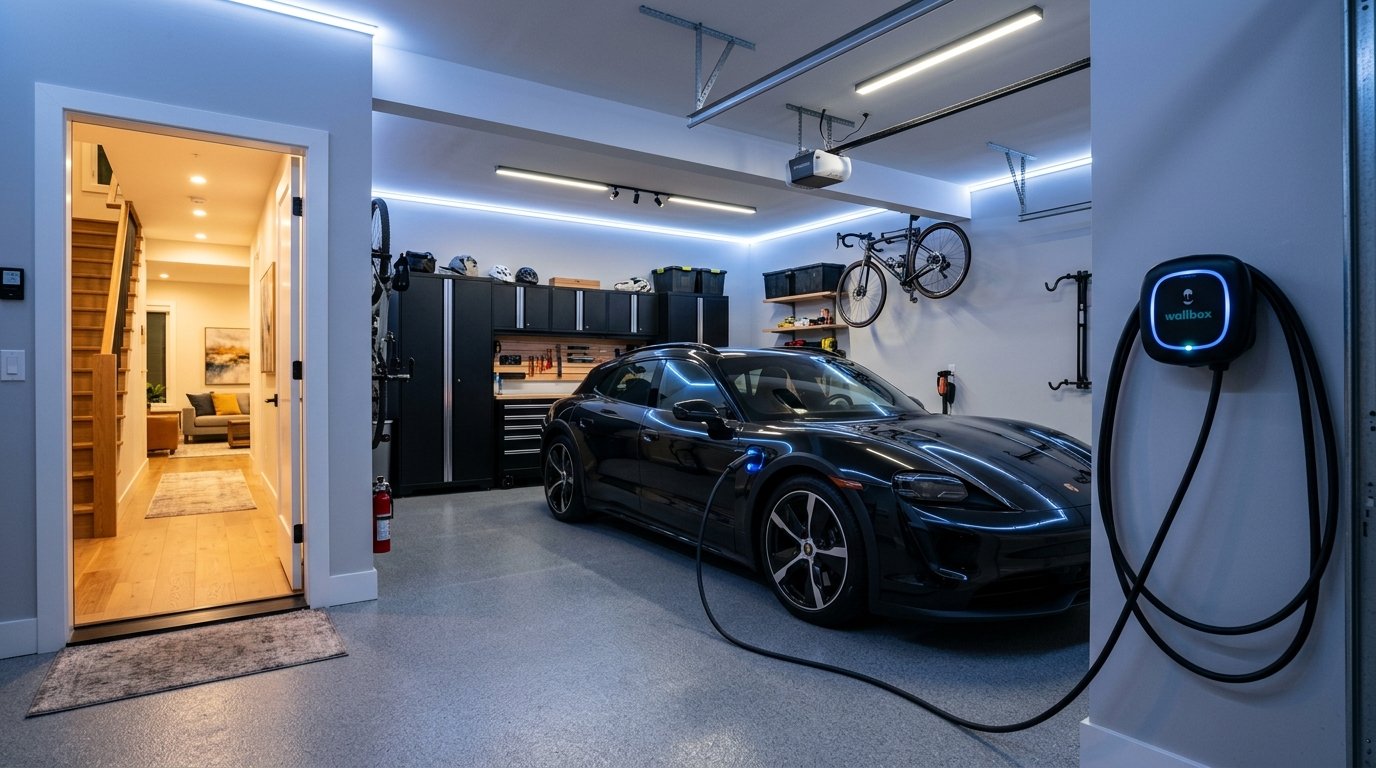
If you’re buying an electric car, you’re going to want a home charger. The slow-charge cable that ships with most EVs (the one you can plug into a regular three-pin socket) works fine as a backup, but for everyday use it’s painfully slow. Depending on your battery size, it might add 15–20 miles of range overnight. That’s genuinely it.
A proper 7kW home charger changes everything. Most people wake up to a full battery every morning. As of June 2026, home EV charger installation cost in the UK typically runs £700 to £1,500 fully installed, but what you actually pay depends on a few things worth understanding before you book anyone.
The honest answer: it varies quite a bit. Let’s break it down properly.
Before installing a home charger, many EV buyers also ask about long-term battery expenses. If you’re curious about replacement costs and battery lifespan, check out our guide on EV battery cost in the UK.
The Two Costs: Equipment and Installation
Home EV charging costs come in two parts: the charger unit itself and the installation labour and electrical work.
People often only budget for one of them. Both matter.
Home EV Charger Equipment Cost (UK)
A standard home charger in the UK runs at 7kW on a 230V single-phase supply. That’s the domestic standard almost every UK house has, and it’s plenty for overnight charging. Most are hardwired, not plugged in, and connect via a Type 2 cable.
Equipment prices in 2026 range from around £350 to £900 for the hardware alone. Here’s what that range actually reflects:
Budget end (£350–£500): Basic tethered units. Reliable, no smart features beyond the legally required scheduling function. Good for buyers who just want to charge the car without complexity.
Mid-range (£500–£900): This is where most buyers land: units like the Ohme Home Pro or Pod Point Solo. Smart scheduling for off-peak tariffs, energy tracking, app control. Most are on the OZEV-approved product list, which matters if you’re claiming the grant (more on that below).
Premium (£900–£1,500+): Myenergi Zappi with solar/battery integration, or the Tesla Wall Connector (£425, but Tesla-specific, so non-Tesla owners need an adapter and lose some smart functionality). Worth it if you’ve got solar panels or a home battery you want the charger talking to.
Installation Cost: The Variable Part
This is where estimates get tricky, because installation cost depends almost entirely on your specific home’s electrical situation.
Best case: Consumer unit nearby, capacity exists (£300–£500)
If your consumer unit (fuse box) is in the garage or near your parking space, has a free way for a dedicated 32A circuit, and the charger can be mounted within a reasonable cable run, installation is straightforward. An electrician runs the 6mm² cable, fits the RCD protection, mounts the unit, and you’re done. This typically takes 2–4 hours.
Typical case: Some additional work needed (£500–£900)
Many homes need a slightly longer cable run, or the consumer unit needs a new way added. If the charger’s going on a post rather than a wall, there’s groundwork too. Expect £500–£900 for installation in this scenario. This is genuinely where most UK households land.
Complex case: Supply upgrade or DNO notification (£1,000–£3,500+)
If you want a 22kW charger, stop. Most UK homes only have a single-phase supply, which caps you at 7kW (or 7.4kW) anyway. Upgrading to three-phase to unlock 22kW charging means an application to your Distribution Network Operator (DNO) and typically costs £1,500 to £3,500+, sometimes considerably more depending on what your street’s existing supply can handle. For the vast majority of drivers this upgrade isn’t worth it: a 7kW charger fully replenishes a typical 60–75kWh battery overnight anyway.
The most reliable way to know your specific cost: get 2–3 quotes from OZEV-approved, NICEIC-certified installers. Most offer free surveys.
Home EV Charger Installation Cost UK: Total Summary
| Scenario | Equipment | Installation | Total Estimate |
| Simple install, consumer unit nearby | £350–£600 | £300–£500 | £650–£1,100 |
| Typical home install | £400–£800 | £500–£900 | £900–£1,700 |
| Complex install / three-phase upgrade | £500–£1,000 | £1,500–£3,500+ | £2,000–£4,500+ |
These are 2026 estimates based on typical UK residential installations. Your actual cost will vary by region, installer rates, and your home’s existing electrical supply.
The OZEV Grant: Who Actually Qualifies
This is where a lot of people get caught out, because the rules changed significantly back in April 2022 and a surprising number of buyers still don’t realise it. It’s exactly the kind of thing that skews home EV charger installation cost in the UK upward if you’d budgeted on the assumption you’d qualify.
The OZEV EV Chargepoint Grant covers up to £350 (75% of installation cost, whichever is lower), rising to up to £500 per socket from April 2026. But, and this is the bit that trips people up, homeowners with their own driveway are no longer eligible. That eligibility ended in April 2022. The grant is now restricted to:
- Renters with off-street parking and landlord permission
- Flat owner-occupiers
- Landlords installing chargepoints at rental properties (separate landlord variant of the grant)
If you own a house with a driveway, don’t budget for this grant. It’s a common assumption that catches people out at quote stage.
Your installer claims the grant on your behalf and deducts it from the final invoice. You never apply for it directly. The charger itself also has to be on the OZEV-approved list (Ohme, Pod Point, Andersen, and others qualify; the standard Tesla Wall Connector does not).
Separately, businesses can access up to £14,000 through the Workplace Charging Scheme, and on-street kerbside charging is funded through local-authority LEVI schemes rather than the OZEV home grants.
Single-Phase vs Three-Phase: Do You Need to Worry About It?
Almost certainly not. Most UK homes run on a single-phase 230V supply, which limits charging to around 7–7.4kW. Three-phase supply (which unlocks 11kW or 22kW charging) is genuinely uncommon in UK domestic properties. It’s mostly found in commercial premises.
For most EVs, 7kW is more than sufficient. A 60–75kWh battery fully recharges in 8–10 hours on a 7kW charger, easily an overnight job. Unless you’re running a high-mileage fleet vehicle or you specifically know your property already has three-phase, don’t pay extra to “future-proof” for 22kW. It’s rarely worth it.
Smart Charger vs. Basic Charger: Is It Worth It?
Since June 2022, all new UK home chargepoints are legally required to have smart functionality: off-peak scheduling and grid protection are built in by law, not an optional extra. Beyond that baseline, smart chargers also let you:
- Track your energy usage and charging costs in the app
- Control the charger remotely
- Integrate with solar panels or a home battery
If you’re on an EV-specific time-of-use tariff , and increasingly drivers are, since overnight rates can drop to 5–10p/kWh versus 25–28p/kWh on a standard tariff , smart scheduling makes a genuinely meaningful difference to your running costs, often more than the grant itself saves you.
Can You Install It Yourself?
No, not really, and this isn’t just caution for caution’s sake. All UK EV charger installations must comply with BS 7671 (the IET Wiring Regulations), specifically Regulation 722, which covers cable selection, circuit protection, earthing, and RCD requirements for EV charge points. Your Distribution Network Operator may also need notifying, particularly for higher-load installations.
Work done outside these regulations can invalidate your home insurance and create real problems if you sell the property. Most manufacturer warranties also require professional, certified installation.
The answer: hire an OZEV-approved, NICEIC-certified electrician. It’s the only way to claim the grant anyway, and it’s not a job worth cutting corners on.
FAQ: Home EV Charger Installation UK
Q: How long does installation take?
A: A straightforward installation typically takes 2–4 hours. If groundwork or consumer unit upgrades are needed, allow a full day.
Q: Do I qualify for the OZEV grant if I own my home with a driveway?
A: No. Since April 2022, homeowners with off-street parking on their own property are not eligible. The grant is now limited to renters, flat owner-occupiers, and landlords.
Q: Can a renter install a home EV charger?
A: Yes, with written landlord permission, and renters can still apply for the OZEV grant themselves provided the property has off-street parking.
Q: Which charger brand is most reliable in the UK?
A: Ohme, Pod Point, Andersen, and Myenergi Zappi all have strong track records for UK residential installations and are OZEV-approved. The Tesla Wall Connector is excellent for Tesla owners but isn’t on the OZEV list.
Q: How much does home charging add to my electricity bill?
A: It depends on your tariff and mileage. A typical driver covering around 800 miles a month might use roughly 240–280 kWh of electricity. On a standard tariff (around 25–28p/kWh) that’s £60–£78 a month; on an EV-specific off-peak tariff (5–10p/kWh overnight) it can drop to under £25, considerably less than most people spend on petrol for the same mileage.
Bottom Line
Home EV charger installation cost in the UK typically lands between £700 and £1,500, before any grant. Know your eligibility before you assume the £350–£500 OZEV grant applies to you. It’s narrower than most people think, and don’t overspend on a 22kW setup you almost certainly don’t need. For more straight-talking EV buying advice, see the rest of our guides on TechUpdateTop.
Prices reflect UK installer quotes and OZEV scheme guidance as of June 2026. Grant amounts and eligibility rules change, so always confirm current terms with an OZEV-approved installer or via GOV.UK before budgeting.